




Protein interactions at the single molecule level
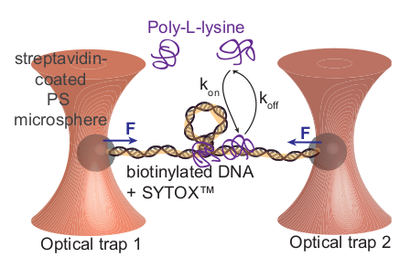 DNA-proteins interactions
Cendrine Moskalenko, Fabien Montel
We investigate DNA-Protein interactions at the single molecule level using optical tweezers coupled with confocal microscopy and microfluidics to probe the mechanical properties and energetics of different DNA and RNA structures in interplay with associated proteins. For example, we investigate R-loops stability involved in genome instabilities (collaboration LBMC), ss/dsDNA forks stabilization and condensate formation in presence of repair machineray (DciA, collaboration I2BC), resolution of DNA hairpin by helicase and its co-factor (WRN and Ku, collaboration I2BC).
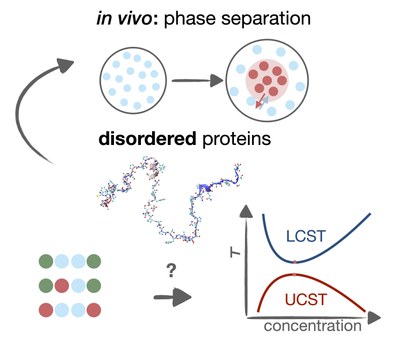 Disordered proteins and polypeptides
Proteins are essential biomacromolecules traditionally thought to require a well-defined three-dimensional structure to function, but it is now known that many proteins are intrinsically disordered (IDPs) or contain intrinsically disordered regions (IDRs) while remaining functional. IDPs and IDRs are characterised by an ensemble of conformations akin to ordinary polymers and often drive the formation of membrane-less organelles. Such a spatiotemporal localisation of biomacromolecules can facilitate chemical reactions and assembly processes, and protect them from harmful environments. Conversely, the alternation in the formation-dissolution cycle of these biomolecular condensates (BCs) is linked to pathological aggregations such as cancer, infectious and neurodegenerative diseases. Our research has focused on two families of IDPs: elastin-like polypeptides and β-caseins. The former are synthetic polypeptides derived from the extracellular protein elastin. The latter are an abundant milk protein that self-organises into micelles. We use all-atom modelling paired with advanced sampling and scattering methods to understand the structure and dynamics of these biomacromolecules. Currently, we are developing a transferable coarse-grained model for disordered proteins that will shed light on how the physico-chemical composition of a sequence affects the material properties of BCs. Stay tuned!