




Dynamics of bacteria
 Dynamics of bacteria and role of environment
Sigolène Lecuyer,Christophe Place
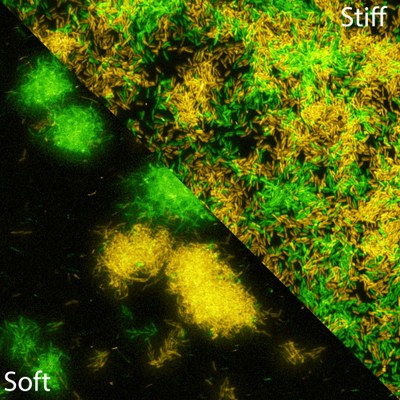
Understanding how bacteria interact with surfaces is essential for controlling colonization, biofilm formation, and infection. Our research investigates the multiscale physical and biological mechanisms that govern bacterial swimming, adhesion, and spatial organization at interfaces. Building on evidence that flagellar hydrodynamics drives bacterial accumulation near surfaces, we study how environmental sensing integrates with near-surface motility. Using microfluidic experiments, we expose E. coli to non-equilibrium chemical gradients and uncover adaptive responses that promote survival and spatial redistribution under adverse conditions. We extend these studies to a broad range of chemical and physical cues, including geometric confinement and electric fields. A second major focus is the early stages of biofilm formation under flow. By combining microfluidics with surface functionalization and patterning, we create well-controlled microenvironments that allow us to observe bacterial behavior in situ. Advanced optical microscopy enables us to dissect how physico-chemical signals regulate adhesion, surface motility, and the emergence of colony architecture through the interplay of physical interactions and biologically-regulated responses. Overall, our interdisciplinary approach bridges single-cell dynamics and collective behavior, providing new insights and strategies to understand—and ultimately control—bacterial colonization on abiotic surfaces and within tissue-like environments