
 Directory
Article - Convergent adaptations of rodents to arid environments
Diverse species adapting to a similar lifestyle may undergo convergent changes in organ structure and cellular function, themselves relying or not on these convergent genetic changes. The extent of genomic convergence is thus debated and may further depend on the interplay between temporal factors, such as species relatedness or the age of the transition. Rodents have repeatedly adapted to life in arid conditions, notably with altered renal morphology and physiology.
In a research article published on March 2026 in Genome Research, the team CIGOGNE (LBMC) in collaboration with teams from LBBE gathered kidney transcriptomic data for 33 rodent species and studied repeated adaptation to aride environments. They found convergence at all examined biological levels, from the whole kidney transcriptome down to the coding sequences and expression level of individual genes. Transcriptome-level signatures reflect convergent changes in cell proportions, suggesting convergent structural adaptations of the kidney.
A large proportion of genes shows convergent substitutions, but those happened in small subsets of species, showing that there are multiple genetic paths repeatedly taken in a mosaic manner. A similar mosaic signal of convergence is found comparing gene expression in species spanning the Rodentia order, but convergence is more widely shared at the lower level of the Murinae family. Therefore, they tested more directly the influence of temporal factors. They observed more convergent changes when they selected species independently adapted from more closely than more distantly related ancestors and when they selected older transitions rather than recent transitions. This study shows that there are many different, yet repeatedly selected, ways to adapt to aridity and that the degree of convergent evolution increases with both the age of the transitions and species relatedness.
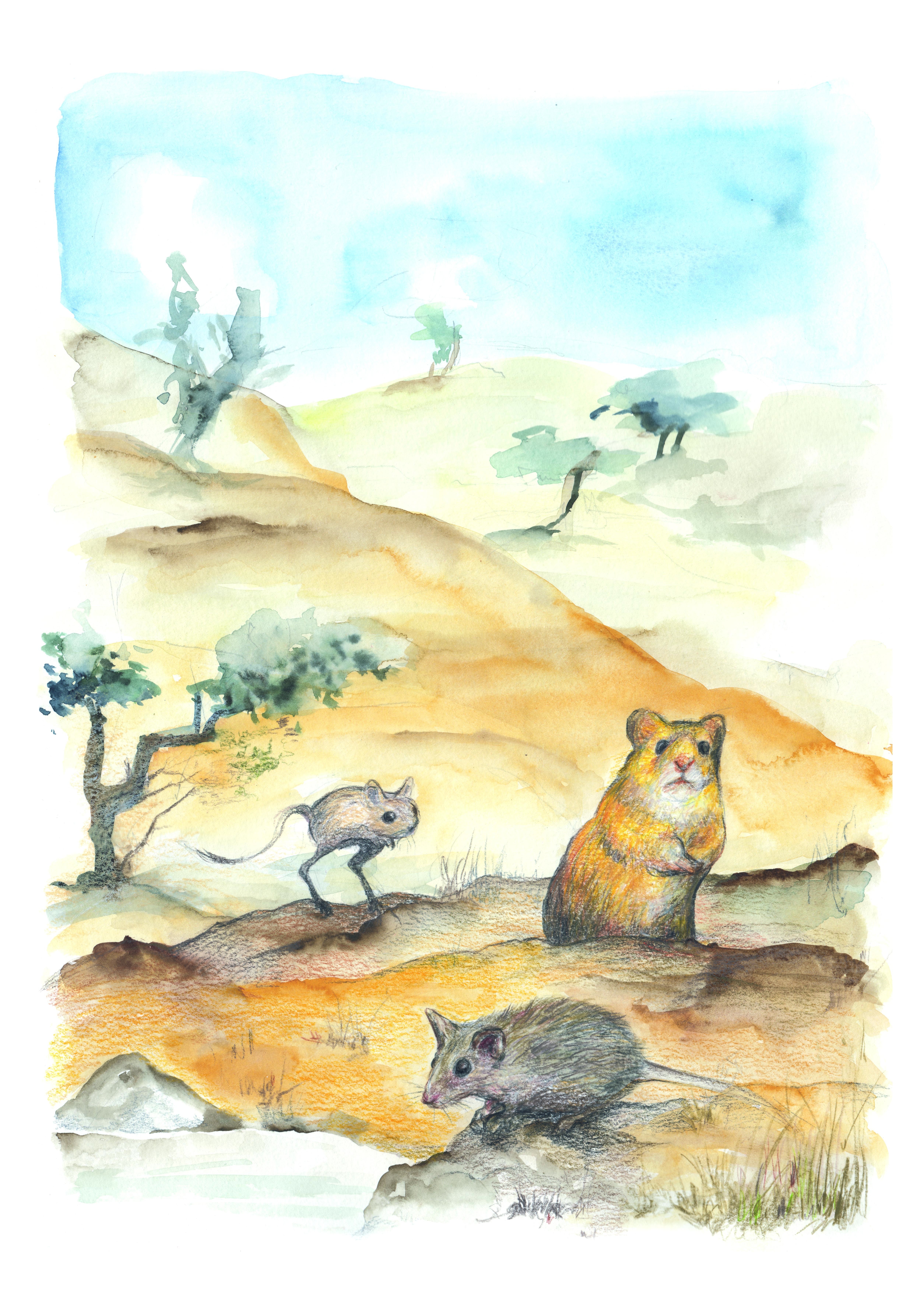
© Marie Sémon