
 Directory



Chiroptic and Plasmonic Systems
We investigate chiroptical and plasmonic systems where light-matter interactions are engineered not only through absorption, emission and scattering, but also through the control of polarization. Our objective is to design molecules, nanocrystals and hybrid materials that display circular dichroism (CD) and circularly polarized luminescence (CPL), and to exploit plasmonic resonances to amplify, tune and transduce these chiral optical responses. By bridging molecular chemistry, nanoparticle synthesis and assembly, and nanophotonics, we create functional platforms relevant to (bio)detection, imaging, photonics and emerging photo-controlled processes.
A distinctive strength of this research axis is the tight integration of chemical design, materials processing, advanced optical spectroscopy and modelling, allowing us to fabricate and investigate a large range of systems from molecules and nanoparticles to chiral nano-assemblies and materials.
Chiral lanthanide complexes
On the molecular side, we develop chiral lanthanide complexes as efficient CPL emitters operating from the visible to the near-infrared.
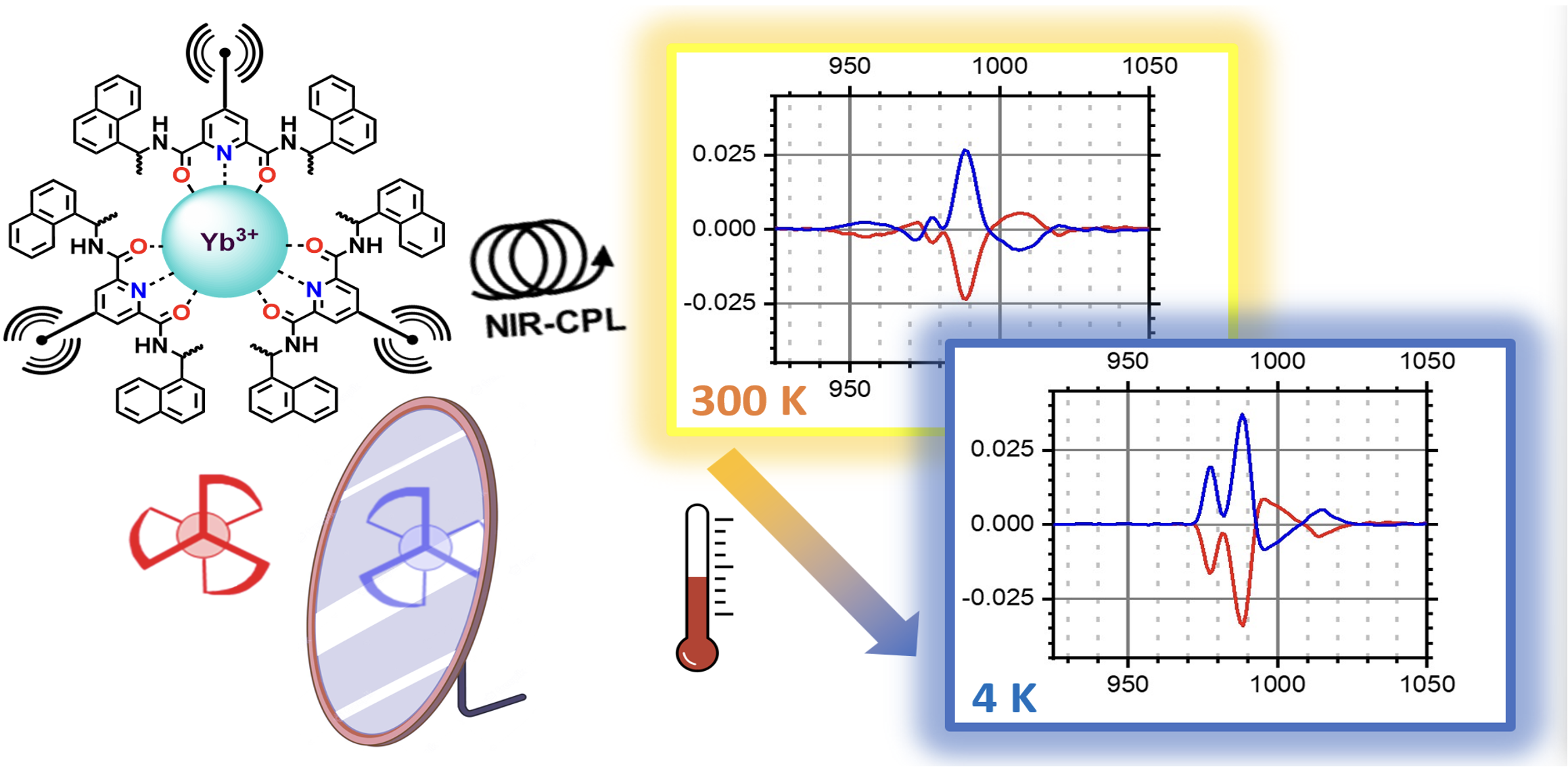 A key asset is the co-development of a new home-made artefact-free CPL spectrometer with the group of Stephan Guy (ILM Lyon) able to perform fast CPL measurements from the visible to NIR spectral range and over a wide range of temperature. This platform enabled to revisit the CPL properties of lanthanide complexes and to evidence the dramatic role of the spectral bandwidth and of the temperature on the CPL response. We have performed the first CPL measurements at low temperature (4K) enabling to determine the "pure" dissymmetry factor of molecular Yb complexes.
We also explore chiral induction by biomolecules (sugars, peptides, proteins) in solution and protein crystals toward CPL microscopy.
Chiral plasmonic nanoparticles
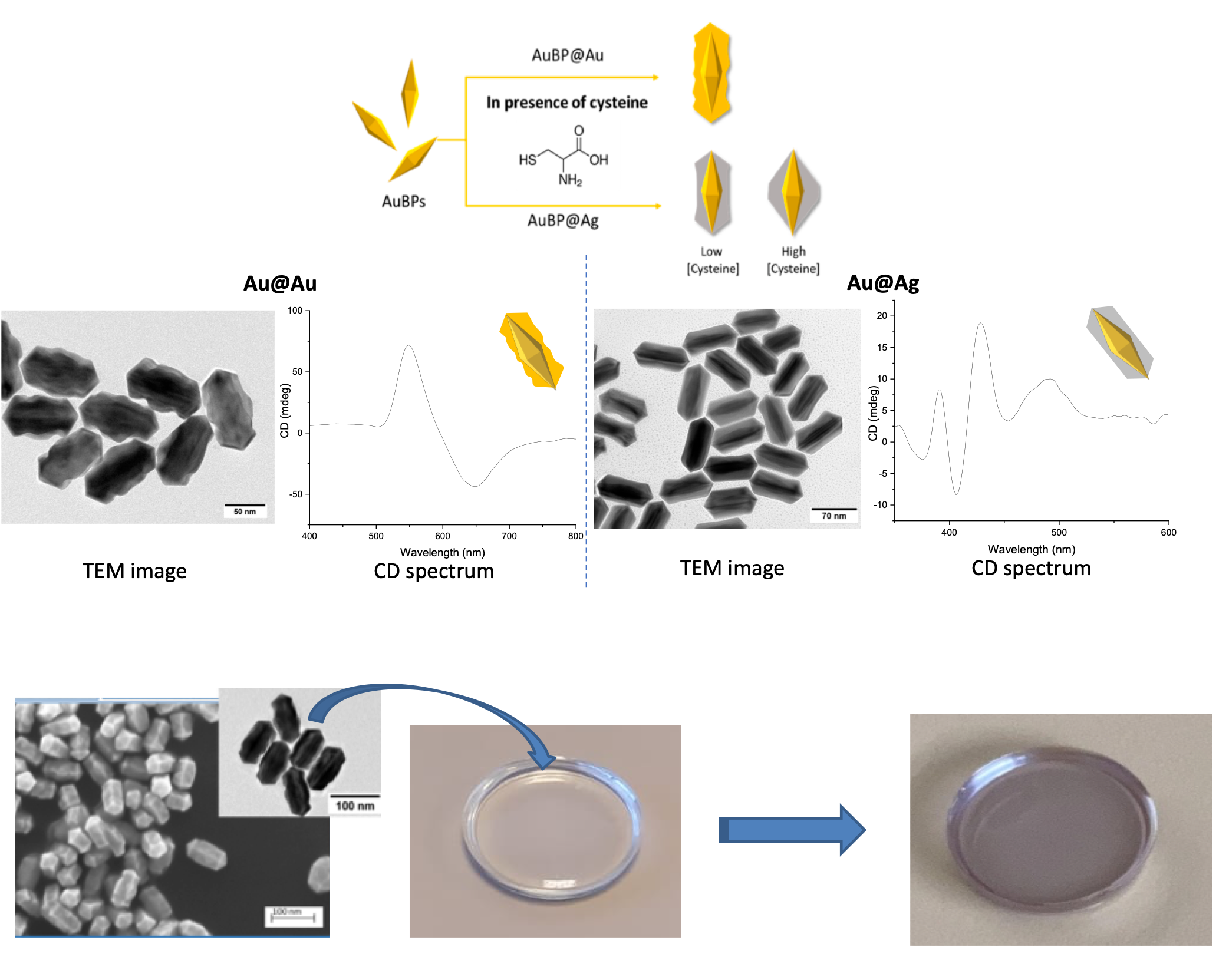 We also focus on the synthesis of chiral plasmonic nanoparticles. Indeed the introduction of chirality into such colloidal materials is a major challenge in nanoparticle synthesis and in optics to which we are making fundamental contributions. Recent advances in the synthesis of pentatwinned gold nanoparticles have enabled their use as substrates for the growth of chiral particles. Insights into the origin of chirality are provided from both experimental and theoretical data.
In addition, strategies for controlling colloidal assembly are being explored in order to broaden the range of particle properties. Finally, the preparation of original hybrid plasmonic glasses for optical applications is being studied.
Plasmonic chiral metasurfaces
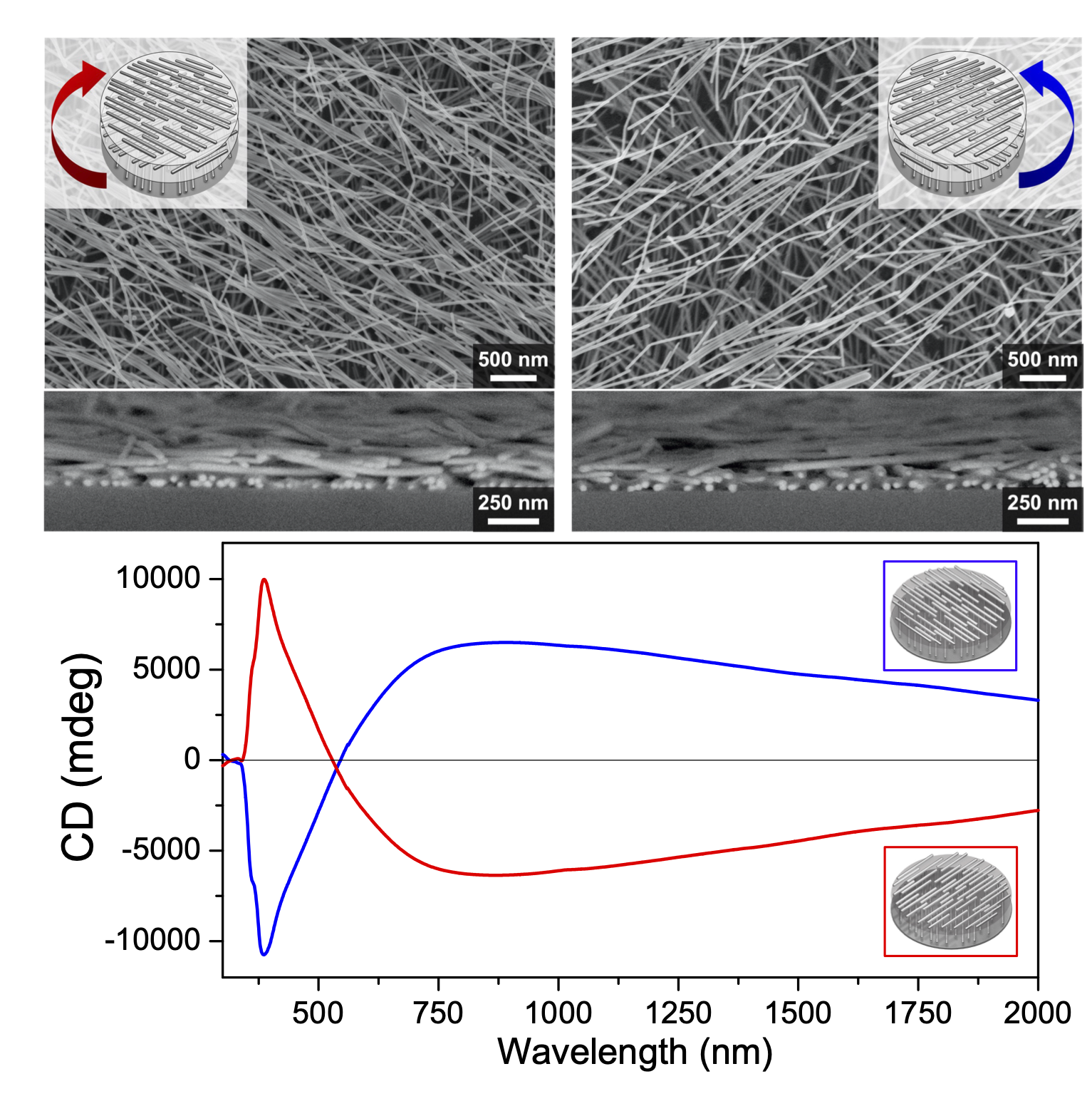
Finally, we also investigate the bottom-up fabrication of plasmonic chiral metasurfaces from silver nanowires and gold nanorods. The approach relies on the combination of Grazing Incidence Spraying (GIS) to produce in-plane anisotropy and Layer-by-Layer (LbL) assembly enabling the construction of hybrid multilayer helical architectures displaying giant circular dichroism extending from the visible to the near-infrared. These metasurfaces can be integrated on semi-reflecting metal films to create chiral mirrors with broadband, structure-dependent differential reflectance for circularly polarized light.
Semiconductor colloidal nanoplatelets
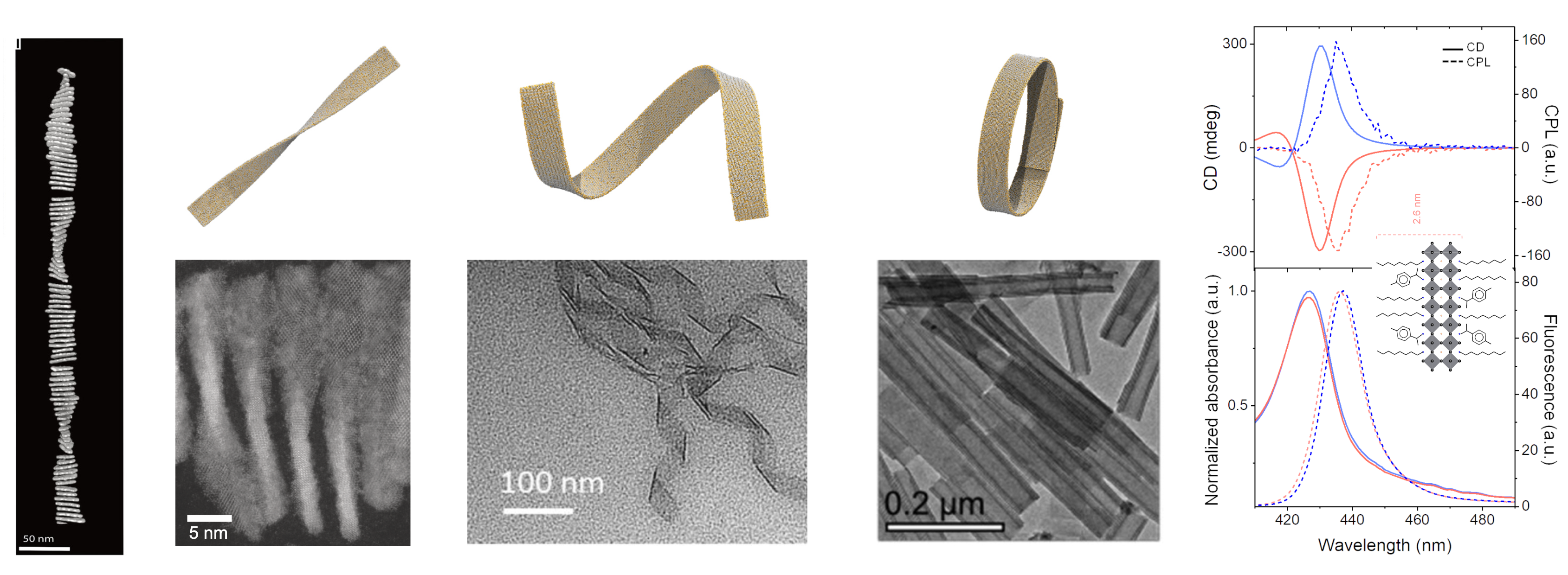 We also explore how chirality emerges in semiconductor colloidal nanoplatelets – from CdSe (II-VI) to halide perovskites – and how it gives rise to spectacular optical properties such as large circular dichroism (CD) and circularly polarized luminescence (CPL). At the heart of this work lies a fundamental open question: how do molecular-scale interactions at the nanoparticle surface – between ligands, and between ligands and crystal facets – trigger symmetry breaking, curvature, and twist across much larger length scales? To tackle this, we combine hands-on experimental work (colloidal synthesis, surface functionalization, self-assembly) with advanced characterization (synchrotron scattering techniques) and modeling approaches (plate mechanics, molecular dynamics simulations). While driven by fundamental curiosity, this research opens exciting perspectives for nanoscale control of charge, spin, and light – with direct relevance to next-generation optoelectronics.