
 Directory


Luminescent Probes for Bioimaging and Therapy
At the laboratoire de chimie of ENS-Lyon (LCH), we design, synthetize and characterize luminescent probes based on organic fluorophores or lanthanide coordination complexes and we are specialized in the Near Infra-Red (NIR) spectral range. We are also strongly involved in the photophysical characterizations of these chromophores using various techniques:
- Steady state and time-resolved spectroscopies (absorption, emission, Vis-to-NIR, variable temperature, lifetime)
- Transient absorption spectroscopy (ns)
- Nonlinear absorption spectroscopy (two-photon cross section)
- Chiroptic spectroscopy (CD, CPL)
- Microscopy
and have all the facilities to carry out these studies!
Our target applications include cells or bacteria imaging, sub-cellular organelles targeting, in cellulo analytes sensing, small animal imaging (mices or zebrafishs), photodynamic therapy using mostly fluorescence microscopy, biphotonic microscopy or photoacoustic microscopy thanks to an important network of collaboration with biologists.
Lanthanide-based luminescent probes
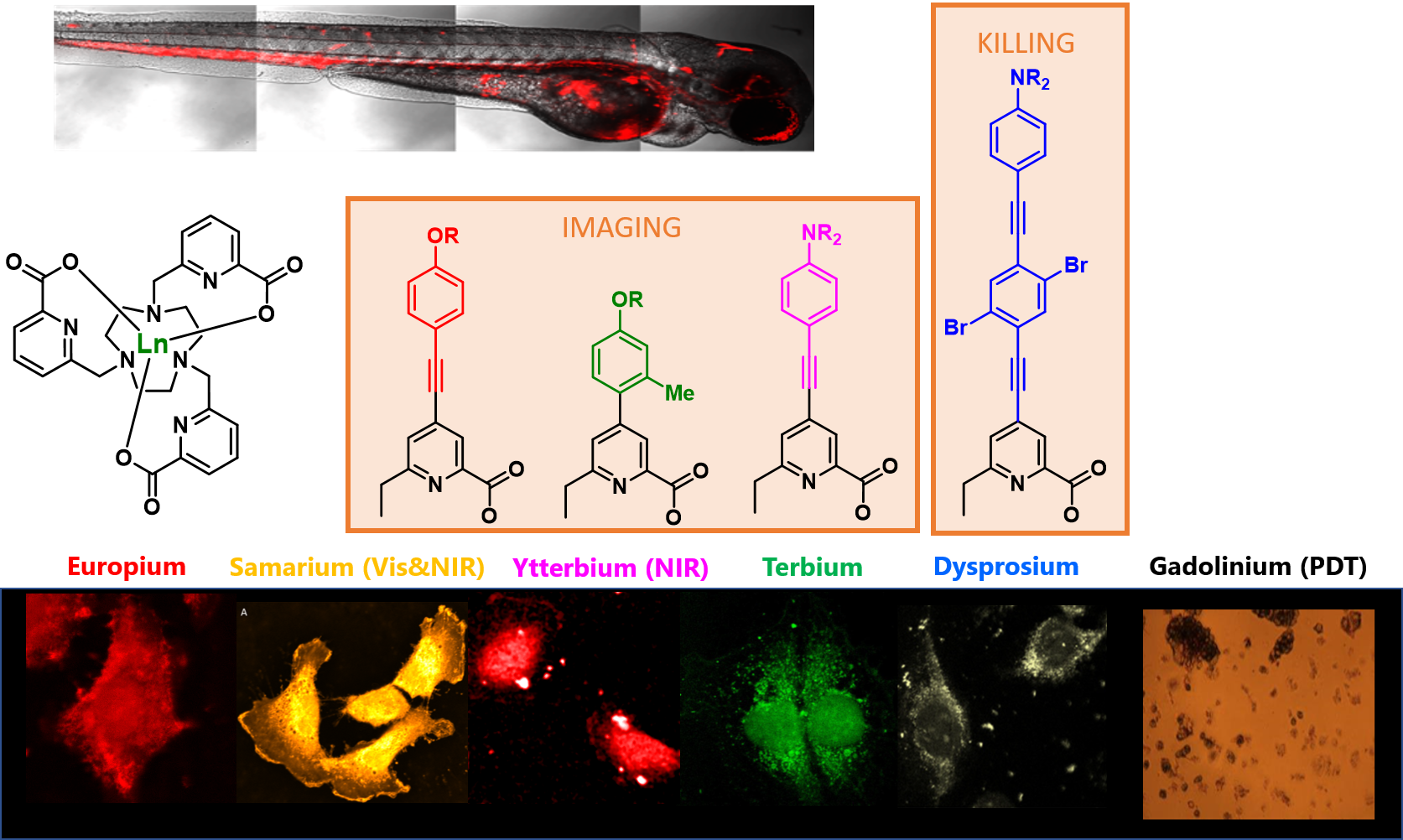 We developed original lanthanide complexes equipped with π-conjugated antenna whose luminescence can be efficiently sensitized by two-photon antenna effect. These complexes can be further functionalized by sugars, peptide or biomolecule to achieve the biological function. We are actually developing two-photon spectro-microscopy in the NIR-II (using Yb and Nd(III) complexes), two-photon CPL-microscopy and two-photon analytes sensing in close collaboration with the groups of O. Sénèque (Grenoble), R. Tripier (Brest), S. Di Pietro (Pisa), A. Grichine (Grenoble), M. Gary-Bobo (Montpellier) and S. Brasselet (Marseille).
Photodynamic therapy
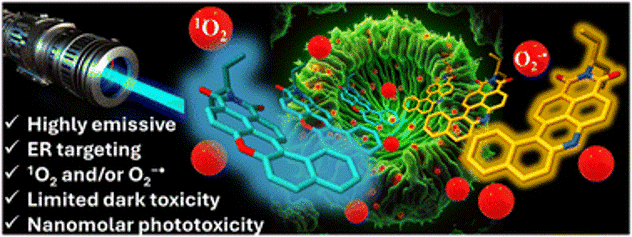 We study small poly(heteroaromatic) molecules with a distorted π-conjugated backbone for applications in bioimaging and photodynamic therapy (PDT). These molecules target non-canonical DNA structures (G4 quadruplex) and exhibit ideal intersystem crossing yields for type I (electron transfer) and type II (singlet oxygen generation) PDT. Two families have been developed: diazonia derivatives and extended benzothioxanthene derivatives (internal collaboration with Axis 1 and 2 and external collaboration with Moltech Anjou, Umeå University, Sweden).
Impact and Collaboration
Our work is supported by French National Research Agency (ANR) grants, INSERM grants and regional innovation agencies. We actively collaborate with academic partners for the advanced photophysical characterization (especially in the NIR spectral range) and with biologists for the target applications.
Current Opportunities
- Master2 opportunities are always available in the group please apply !!!
- Postdoc opportunity: Analyte sensing using lanthanide complexes (September 2026)