




Écoulements en conditions extrêmes
 Magnetohydrodynamics and plasma turbulence
Nicolas Plihon, Philippe Odier, Mickaël Bourgoin, Jean-François Pinton, Vincent Dolique
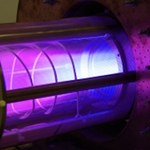
Our team has been involved in turbulent dynamo studies, especially experimentally, using liquid metals over more than 15 years. The von-Karman Sodium collaboration (ENS de Lyon, ENS Paris, CEA Saclay) has demonstrated the existence of turbulent dynamos using liquid sodium. A smaller scale versatile semi-synthetic dynamo has also been developed, which displays several features interesting for the understanding of natural dynamos (terrestrial or stellar dynamos). Thanks to cutting-edge instrumentation, we also have a strong expertise on MHD turbulence. Next generation dynamo experiments will use plasmas as conducting fluids (allowing to reach parameters closer to that of stellar dyanmos). We have developed a plasma-experiment (see photo) where controlled and shaped flows can be driven, allowing for the understanding of momentum coupling to the plasma and momentum and magnetic field transport in turbulent regimes, as weel as the influence of flows on the stability criteria of a magnetized plasma column (drift waves). A first step towards next generation plasma dynamos!
 Superfluid turbulence
Julien Salort, Francesca Chilla
We use superfluid Helium to explore the turbulence in quantum fluids. One motivation is to investigate how turbulence and non-linear mechanisms interplay with small scale mechanisms. The dynamics of superfluid turbulence is strongly determined by the physics ofquantum vortices, and the dissipation mechanism at small scale are very different from classical fluids. However, statistical features and large scale behavior of classical fluids are mostly recovered when the turbulence is sufficiently developed. We participate in international collaborations which aim at setting up highly turbulent quantum flows, such as the SHREK experiment in Grenoble, and we develop our own experimental apparatus in Lyon, focused on intermediate cases. A large effort is devoted to instrumentation, based on dedicated micro-sensors, used by several collaborators.