



Dynamique des écoulements turbulents
 Particle Motion in turbulent flows
Romain Volk, Mickaël Bourgoin, Jean-François Pinton
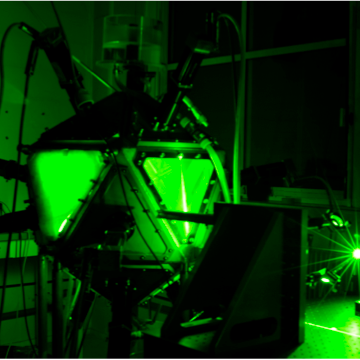
Our group has a well-recognized expertise in the experimental study of particle transport in turbulent flows. In the last decade, we have pionnered a number of innovative techniques to actually follow the motion of various types of particles and has contributed to the description and modeling of finite-size particles dynamics in turbulence. This includes laser-Doppler methods, or methods relying on tracking of particles with several high-speed cameras. These techniques are currently used to study preferential concentration of inertial particles in turbulence, rotation and melting of solid particles, and long time dynamics of very large objects when followed for thousands of large eddy turnover times.

The possibility to follow reliably particle motion in a turbulent flow suggests a new way to investigate turbulence itself: what characterises the motion of one particle transported by the flow? what happens to a small number of particles? The study of the motion of tracer particles leads to a rich phenomenology, and to unexpected properties, such as the intrinsic asymmetry between acceleration and decelerations of particles motion. A related, but different class of project concerns the motion of small, heavy particles in a dilute suspension, for which we are focusing on the rate at which two particles get together (collision rate).
 Thermal convection
Francesca Chilla, Julien Salort, Louis Couston
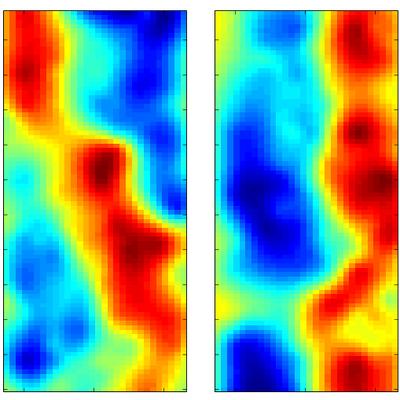
Our team has 20 years experience in turbulent thermal convection and our present work are following this direction. We use high Rayleigh model systems as Rayleigh Bernard cell which is essentially controlled by boundary layers and vertical or tilted convective duct connecting larger differentially heated chambers. In the first case boundary layers can be tackled using roughness in the second case the bulk is independent from boundary layers and the flow sustained by a mean gradient. We perform both calorimetric and PIV measurements and we are developing other original technics as back oriented Sclhieren, Mems probes, lagrangians large size probes. We are also developing lagrangian following of particles to characterize the transport and mixing in the whole flow.