




Ondes et écoulements
 Internal waves and rotating flows
Sylvain Joubaud, Philippe Odier, Antoine Venaille, Thierry Dauxois, Louis Couston
The study of internal waves is of great interest owing to the evolving appreciation of their role in many geophysical systems. In addition to their particularly intriguing properties from a fundamental point of view, these waves play an important role in dissipating barotropic tidal energy in the ocean, transporting momentum in the atmosphere, while their activity also impacts modern-day technology. However, many unanswered questions remain, particularly regarding the fate of internal waves and how much mixing they generate in the ocean and via which processes. We study these questions using several experimental techniques (PIV, Synthetic Schlieren, LIF) while developping also a theoretical understanding. Taking advantage of an innovative new wave generation in stratified fluids, combined with a recently acquired 2-meter rotating table, we tackle different geophysical questions of interests.
 Flow in complex wave field
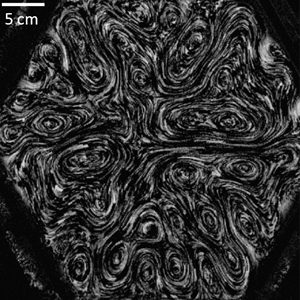
Interactions between currents and waves is an old yet still open problem of fluid mechanics. In particular, the surface flow generated by an arbitrary wave pattern exhibits rich features that are still to understand, with strong applications for transport in natural environment. We currently develop in the lab a versatile experimental platform to systematically investigate this question combining several experimental techniques (Schlieren, PIV, PTV). We aim in particular to find correlations between peculiar points of the wave field (cancellation points/lines) and the main features of the generated flow (large currents, strong vorticity areas).
 Frustration in spatio-temporal media
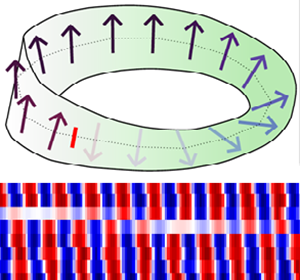
Frustration occurs whenever the spatial organization of a composite system forbids all its parts to be simultaneously in their minimal energy configuration. Recently, time modulation of materials appeared as a new degree of freedom in the context of wave control. We therefore currently study in the lab the generalization of frustration to spatio-temporal media, which present periodicity both in space and time. We have shown that spatio-temporally frustrated states have strong ‘wave-like’ dynamical signatures that are still to explore. Several experimental platforms are currently developed using vibrated fluid or active mechanical systems.