


SpaceX's Crew Dragon 12 rocket successfully lifted off on February 13, 2026, carrying French astronaut Sophie Adenot, who was tasked with deploying MATISS-4. This experiment, led by Laurence Lemelle (CNRS, LGL-TPE, ENS de Lyon) was assembled by the LPENSL mechanical engineering department, under the supervision of Denis Le Tourneau. Photo credit: © NASA/ESA
Preventing biocontamination in space
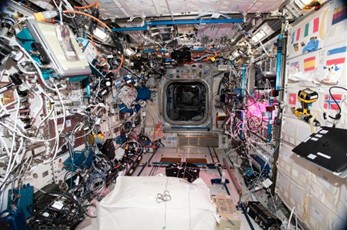
In concrete terms, this project involves studying smart surfaces in microgravity to prevent biocontamination in the International Space Station (ISS). It is one of many experiments investigating strategies to limit surface biocontamination, a major challenge for long-duration manned flights in order to protect the health and time of astronauts.
“In the MATISS experiment conducted by ENS de Lyon, CNES, and CNRS, we are analyzing contamination spreading through the air in the form of bioaerosols, explains Laurence Lemelle, CNRS research fellow leading the project at the LGL-TPE laboratory. After demonstrating that the surfaces of the Columbus module cabin are generally kept clean, while revealing significant cumulative biocontamination over the long term and the effect of certain surface treatments, MATISS-4 aims to characterize in greater detail the morphology, composition, and immediate environment of micrometric deposits on model surfaces. These deposits will be analyzed on silicon surfaces (Silson) using X-ray nanoimaging at the European Synchrotron Radiation Facility (ESRF) in Grenoble, which offers the best elemental and spatial sensitivities currently available.”
An evolving and collaborative project
Such an experiment relies on the development of a device that can both collect and observe these deposits, which involves considerable work carried out in collaboration with numerous partners.
“I would like to acknowledge the work of Denis Le Tourneau, from the mechanical engineering department of the ENS de Lyon physics laboratory, who, in collaboration with the micromechanics experts at ESRF (François Fihman, 6Tec), has managed to preserve the functionality of previous devices while upgrading them to enable this study,” comments Laurence Lemelle.
Next step: deploying the experiment on the International Space Station
She adds that the launch of Sophie Adenot, an astronaut with the European Space Agency (ESA), who will carry out the collection operations on board the International Space Station, was a success. “After this emotional moment, the next major step for our team will be the deployment of the experiment on the ISS (International Space Station), scheduled for April,” she said.