
 Annuaire
Présentation et Recherches
The Piazza lab is located at the laboratory of biology and modelling of the cell (LBMC) in the privileged scientific environment of the Ecole Normale Supérieure (ENS) campus in Lyon. Our goal is to understand in quantitative terms the basic mechanisms involved in the repair of DNA break, their interplay with the higher "cytological" order of chromatin in the nucleus, their evolutive implications, and consequences of their defects for genomic stability. To this end we use human's best friend: budding yeast!
Studying recombination in cells has been complicated by a lack of tools to track the core, labile intermediates of the pathway: heterologous contacts made during homology search and DNA joint molecules formed upon successful homology identification. Consequently, we developed several molecular and genomic approaches to close this technical gap and gain direct access to the core steps and regulations of the pathway (Piazza et al. Methods Enz 2018; Piazza et al. Mol Cell 2019, Reitz et al. J. Vis. Exp 2022; Reitz et al. Genes Dev 2023; Dumont et al. Mol Cell 2024; Mendiboure et al. Bioinformatics 2026). You can find our detailed lab protocols and associated analysis software in the “protocols” section. We also develop computational models of the process under investigation in collaboration with the Jost lab at the LBMC. Finally, we develop large-scale re-engineered chromosomal regions to address the impact of chromosome (re-)organization in cis (more on that soon).
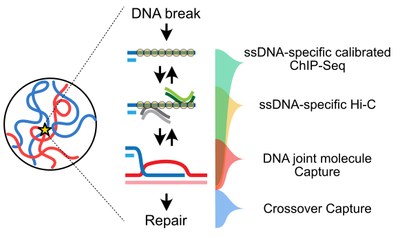
The general take here is that most past work focused on recombination proteins/complexes in isolation, which proved extremely useful to define the biochemical activities of these recombination proteins and their cellular function. However, it largely left open the question of how recombination is enacted in the native context of chromatin in cells, in which myriads of other processes concurrently act. Our goal is thus to define how recombination impinges on other DNA-dependent processes, and conversely how these processes regulate, participate in, or are even integral to the recombination process.
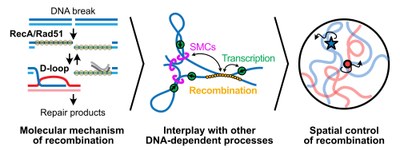
This led us to investigate the interplay between DNA recombination and chromatin looping by the SMC complexes cohesin and condensin (Piazza et al., Nat Cell Biol 2021; Dumont et al. Mol Cell 2024; Piveteau et al. EMBO J., 2026), as well as with transcription by RNA Polymerase II (Djeghmoum & Piazza, EMBO J. 2025).
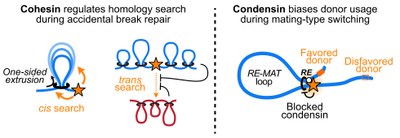
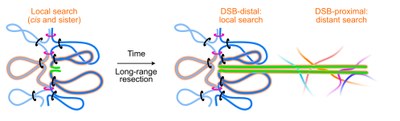
The recombination step that has captured our interest for a long time is homology search, in which the broken site searches the genome for a homologous match. This search has two obvious requirements: an opportunity for spatial encounter between the broken molecule and the intact homologous sequence; and the ability to identify a homologous sequence (amidst the massive excess of non-homologous DNA of the genome). Previous cytological work suggested that changes to chromatin properties allowed distant sites to come in contact in the nucleus, fulfilling the first requirement. However mutant defective for this change in mobility repaired just fine with distant homologous donors. By developing a variant of Hi-C to map ssDNA contacts, we instead proposed that the growth of long, rigid Rad51 filaments acts as a fishing rod enabling homology search across the nucleus (Dumont et al. Mol. Cell 2024; Piazza & Taddei, COGD, 2026). We use this novel framework of homology search to understand what role recombination proteins exert on Rad51 filament structure and overall search reach (Mendiboure et al BioRxiv 2026).
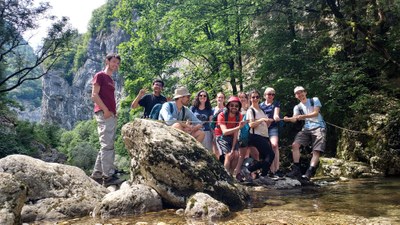
The lab is an enthusiastic bunch of 8 +/- undergraduate students, and we would be thrilled to have equally dynamic and creative individuals joining us!
Follow us on Bluesky: aurelepiazza.bsky.app
