


On January 12, 13, and 14, 2026, as they have done since 2018, first-year Master's students in the Biology Department had the pleasure of welcoming middle and high school students from the Lyon metropolitan area to the Biosciences Forum.
This forum is one of the events that gives secondary school students an opportunity to learn about our School and strengthens ties with ENS de Lyon’s partner institutions as part of the Cordée de la Réussite (Success Network) initiative, “ENSemble, construisons ton avenir” (Together, let’s build your future).
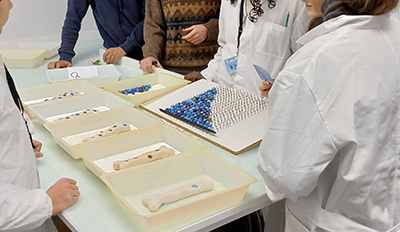
This year, two classes from La Martinière High School in La Duchère came to work on the world of viruses and epidemiology and infectious diseases, respectively. Students from the Science Department at Gabriel Rosset Middle School in Gerland had to conduct a paleontological investigation to identify a mysterious fossil found in the neighborhood. Students from Honoré de Balzac Middle School in Vénissieux learned all about pollen, while those from Jean Jaurès Middle School in Villeurbanne were asked to question the fake news they encounter on a daily basis.
For our students, the forum, which is an integral part of their Master's degree program, is an opportunity to develop scientific communication skills, but also to take a step back and reflect on their scientific practice and knowledge, and to consider their place as scientists within society.
For the high school and middle school students we welcome, the workshops offer an opportunity to discover science in a rigorous yet fun way, covering a variety of topics related to their school curriculum, their daily lives, or current issues. This year's program included:
- experiments involving observations of pollen and bacteria;
- interdisciplinary activities: geology, chemistry, and mathematics were combined with biology to date fossils, and physics was used to understand how a nuclear power plant works, thanks to a colorful model;
- immersion: some were able to immerse themselves in the atmosphere of a cabinet of curiosities, while others had to explore the inside of the lungs or a cell.
And in all cases, there is a lot of involvement from young people and our students in advancing our understanding of the world around us!
This was a highlight of the Biology department's academic year, made possible by the Cordées de la Réussite program, as well as the support of ENS de Lyon's administrative services and the involvement of the Biology department's teaching and technical teams and our colleagues in Physics and Chemistry: a big thank you to everyone! See you next year for new discoveries in biology and science outreach!
Aurélie Vialette on behalf of the Biosciences Forum team