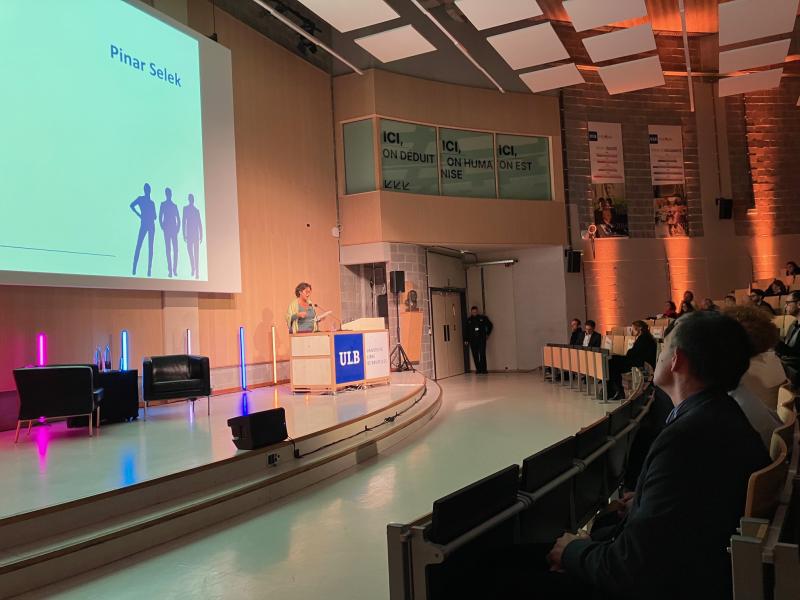
Already acquitted four times, sociologist Pinar Selek will once again face Turkish justice on October 21, 2025. As part of the international academic community's mobilization, the Free University of Brussels organized a large solidarity demonstration on October 15, 2025. Among the personalities invited to show their support and speak out in defense of academic freedom, Emmanuel Trizac spoke on behalf of France Universités.
Facing repeated lawsuits since 1998, the sociologist, who has been living in exile in France since 2011, has been teaching at the University of Nice since 2016. She was awarded an honorary doctorate from ENS de Lyon in 2013 and became an honorary citizen of the City of Lyon in 2023.
Emmanuel Trizac’s speech
“ ENS de Lyon has a special relationship with Pinar Selek. It was an honor to award her an honorary doctorate in 2013, and then to welcome her to the Max Weber Center as a visiting professor. Her ties to the city of Lyon have grown stronger over time. Pinar is now an honorary citizen of the city, and it was in Lyon that a support base was organized in June 2024 for her fifth trial. However, I am not here solely to represent my institution, but to speak on behalf of France Universités, the association of French public higher education and research institutions, universities, and grandes écoles.
The relentless persecution of our colleague Pinar Selek is unbearable. What is her crime? Conducting research on the Kurdish question. For more than 25 years, her life has been a long series of bogus trials, acquittals, and new proceedings. In 2024, her participation in a round table organized as part of an academic event under the auspices of the CNRS, the UCA, the IRD, and Paris-Cité University led to new charges of participating in an event linked to a terrorist movement.
These new charges target French universities and seriously undermine academic freedom. They aim to intimidate an entire community, to silence it, and they remind us that academic freedom is coming under increasing pressure in Europe and around the world.
Right now, against this backdrop of growing threats, France Universités is holding a conference at Sorbonne Nouvelle University on the subject of academic freedom. It is entitled “And yet it moves,” in reference to what Galileo is said to have muttered in 1633 when he recanted his theory that the Earth revolves around the sun.
Indeed, academic freedom is one of the pillars of a functioning democracy. Democracy cannot operate without the independence of academics from political, economic, and religious powers. What is at stake is enormous: our ability to deliberate on what we call the truth, to establish facts, to decide on issues, to agree on our disagreements when controversy arises, to fight against misinformation, to counter the hollowing out of the meaning of words that we see at work, or even a complete reversal of meaning. Post-truth is one facet of this reality. In short, what is at stake is the social contract and our ability to still talk to each other in a society that is being pushed towards anomie.
On this weakening of thought and language, I would like to quote Goebbels. I don't do this often; this is actually the first time. But I believe his words are particularly relevant today. “I don't want you to think like me, I want you to be able to think only like me.”
And so as not to leave the last word to Goebbels, I would like to mention an author who I believe is dear to Pinar Selek, particularly for her analysis of violence and domination in politics. That author is Hannah Arendt. Hannah Arendt urged us to “think without hindrance,” even if it meant causing discomfort. It is difficult, it is risky. This is what Pinar Selek does. You cannot imprison thought!
I reiterate our commitment to Pinar Selek and her unwavering character.”