


On the occasion of the induction of Marc Bloch and his wife, Simonne Vidal, into the Panthéon on June 23, 2026, the École normale supérieure de Lyon honors the legacy of one of the most influential figures in modern French history and in the development of history as a discipline.
Through its partnership with the Marc Bloch Center in Berlin, ENS de Lyon is committed to preserving and advancing the intellectual legacy he left behind. Marc Bloch’s influence remains as vital today as ever—as a pioneering historian, a courageous member of the French Resistance, a deeply engaged public intellectual, and, above all, a man guided by an unwavering commitment to truth and freedom.
Marc Bloch: Scholar and Resistance Fighter
Born in Lyon in 1886, Marc Bloch was one of the most influential historians of the twentieth century. A graduate of the École normale supérieure in Paris, he built a remarkable academic career, which included teaching at the Écoles normales supérieures of Fontenay-aux-Roses and Saint-Cloud, two schools whose history is closely linked to that of today’s ENS de Lyon.
Appointed Lecturer in Economic History at the Sorbonne in 1936 and Professor the following year, he continued his work as a historian and teacher until he volunteered to serve in the French army in 1939.
Born in Lyon, Bloch would return to the city during the Second World War, where he became one of the leaders of the United Movements of the Resistance (Mouvements unis de la Résistance) in the Rhône-Alpes region. Arrested by the Gestapo on March 8, 1944, he was imprisoned at Montluc Prison in Lyon, where he was tortured. He was executed by the Germans on June 16, 1944, near Lyon.
Today, his name is inscribed on Lyon’s memorial plaque honoring those who died for France during the Second World War, which was installed in 2000. On his grave in the Creuse region, according to his wishes, are engraved the words: “Dilexit Veritatem” — “He loved the truth.”
A Leading Historian
Marc Bloch remains a major reference for historians and researchers in the humanities and social sciences around the world. The Historian’s Craft (Apologie pour l’histoire, ou métier d’historien) became his most influential reflection on the historian’s role. Published in 1949 by Lucien Febvre, with whom he founded the journal Annales d’histoire économique et sociale in 1929, the book called for a critical and interdisciplinary approach to understanding the past. Written in response to a fundamental question— “What is the point of history?”—the work presents history as a way of understanding human societies through time.
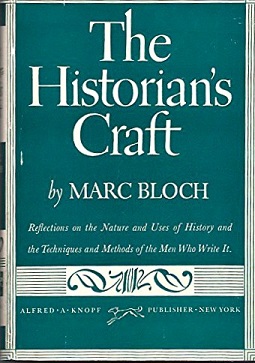
This vision had a worldwide impact and continues to resonate across generations. Translated into more than twenty languages, Bloch’s writings influenced generations of historians across the world. He described history as “a science of human beings in time,” adding: “History connects the study of the dead with that of the living; it is not a science of the past, it gives meaning to the present.”
An Intellectual Committed to Truth and Critical Thinking
Throughout his life, Marc Bloch placed intellectual rigor and the search for truth at the center of his work. During the First World War, while serving as a soldier, he reflected on how beliefs, emotions, and collective perceptions shape opinions during times of conflict.
In 1921, he published “Reflections of a Historian on the False News of War”, an article examining the spread of rumors and misinformation during wartime. More than a century later, his reflections continue to resonate with contemporary questions about the circulation of information.
After taking part in the Battle of France in 1940, Bloch analyzed the causes of France’s defeat and wrote Strange Defeat (L’Étrange Défaite), a work examining the failures that led to the collapse of 1940. In the testament he wrote on March 18, 1941, Marc Bloch expressed the principle that guided both his life and his scholarship:
“Throughout my life, I have always striven, to the best of my ability, for complete sincerity in thought and expression. I consider any acceptance of falsehood, whatever justification it may claim, to be the greatest corruption of the soul.”
The words he wished to see engraved on his tomb — Dilexit Veritatem (“He loved the truth”) — remain a powerful expression of his commitment to honesty, intellectual freedom, and the pursuit of knowledge.
Marc Bloch’s Enduring Legacy
As part of the commemorations surrounding Marc Bloch’s induction into the Panthéon, ENS de Lyon, in partnership with the Centre Marc Bloch in Berlin and the Bibliothèque Diderot de Lyon, is organizing initiatives to share his work and legacy with new audiences.
Among these initiatives is the exhibition “History in Search of Its Place” (“L’Histoire cherche son lieu”), created with artist Anaëlle Vanel, a graduate of the École nationale supérieure des beaux-arts de Lyon. This exhibition will be presented at ENS de Lyon on September 30, 2026, and one of the works will become part of the our School’s collections and be displayed in the History Reading Room of the Bibliothèque Diderot de Lyon.
Moreover, the exhibition has been awarded with the Biennale Art contemporain Label as part of Résonance, “a major gathering for contemporary art professionals and cultural actors in the Auvergne-Rhône-Alpes region.”
Résonance brings together a range of events held alongside the Biennale de Lyon, organized by art centres, galleries, cultural institutions, nonprofit organizations, and artist collectives.
Find out more about the Centre Marc Bloch’s program
Series of podcast “Radio Marc Bloch” from the Centre Marc Bloch in French, German and English