


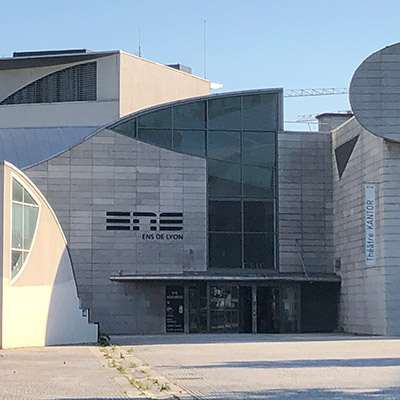
ENS de Lyon's 2025-2028 institutional project sets out the main lines of its roadmap for the coming years, ensuring that the School's operations and future actions in all their forms will meet the expectations and challenges facing our societies. The world is in a state of flux, with some of the balances and models we thought were established now faltering. How can ENS de Lyon, through its public service missions and specific characteristics, contribute to clarifying the future and working towards its transformation in the coming years?
This project was developed through discussions between the School's governing bodies and communities, particularly during the consultation process launched at the general assembly in December 2023. It has been presented to the relevant bodies.
An original model
As an ENS, we are based on an original model: a grande école in terms of recruitment, we join universities in the missions that drive us. Research is at the heart of our activities, closely linked to cuttingedge training, the dissemination and mediation of knowledge and expertise, and their promotion through partnerships with the economic, cultural and NGO sectors.
Research is at the heart of our mission, closely linked to training, knowledge dissemination and mediation, in partnership with the economic, cultural and NGO sectors. Our students are our greatest asset.
While research is at the heart of our mission, the students we train are our greatest asset and one of our strongest contributions to the Community of tomorrow. As a school of the Republic, we must also be a bridge between knowledge, citizens and political and economic decision-makers, a school open to the world as a whole, with an international outlook.
Missions to shape the world of tomorrow
Advancing knowledge; training teachers (our founding mission statement); training scholars, senior civil servants, diplomats and executives in the public and private sectors; creating the conditions for responsible innovation; widely disseminating scientific culture and training those who will pass on knowledge and understanding of the world: the challenges are immense.
The challenges are immense, whether scientific, societal, environmental, economic or geopolitical.
They consist in helping to shape the world of tomorrow, training its actors and making knowledge a common good.
Values that define us and obligate us
Along this path, the values inherited from our history, enriched by all the exchanges that formed the foundation of the school, invite us to be particularly vigilant on issues of diversity, inclusion, but also of ethics and academic freedom.
Diversity, inclusion, ethics, academic freedom.
Those are values fundamental to the very spirit of teaching, research and, more broadly, to the public interest that guides our actions. It is our responsibility to articulate them in line with the community’s expectations and its desire to play a more active role in shaping the direction of research.
In the spirit of openness
This project is characterized by openness: openness to academic partners, social and geographical openness, disciplinary and interdisciplinary openness, openness to the world with a particular focus on the issue of transitions.
A particular focus on the issue of transitions.
The challenge is not only intellectual and ethical; it also requires us to rethink our organization. We are dependent on the complex workings of higher education and research in France, which suffer from a real lack of resources. With the Financial sustainability of the institution now at stake, we must generate revenue for the future and give ourselves the means to achieve our ambitions. We must also ensure that the projects we undertake are the subject of genuine consultation, and that the resources, particularly human resources, required to carry them out are taken into account. This is how we will continue to rank among the top research institutions, how we will continue to attract critical, rational, curious, inventive and determined minds, and how we will continue to encourage them to interact in fruitful exchanges in order to produce, transmit and share knowledge.
Our world, where a certain indifference to truth and reality tends to develop, where the free circulation and exchange of ideas is declining, requires such an approach.
A fruitful hybridization between research and education
Our culture is based on the fruitful hybridization of research and education. The presence of 2500 students (of whom 450+ PhD students) is a major factor in our institution’s appeal. This attracts top-quality scholars, who often join us after an international career. The high number of Awards and grants we have received, relative to our overall size, also reflects on the recognition of the scientific quality of ENS de Lyon.
The contribution of research organizations is essential.
Our vibrant research community is also strongly supported by national public research organizations (CNRS, INRIA, INRAé, INSERM), whose strategic, human and material contributions are essential.
Their support must be duly recognized, as they are the spearhead of national research policy. The close ties between the student and research communities extend beyond our campuses; the School is a breeding ground for young researchers who go on to work at leading universities in France and abroad.
The PhD program plays a central role, extending the curriculum offered by the ENS degree.
With specific doctoral contracts for École Normale Supérieure students, we place a strong emphasis on the PhD, which is an important extension of the education we provide, particularly within the framework of our degree program.
A very favourable training and research environment
The policy of ENS de Lyon is to make the instruction and research environment as functional and efficient as possible, whether in terms of support staff, equipment, premises, documentation policy or services to researchers. The “research fund”, which is unique to the institution, makes it possible to fund emerging projects, international conferences and junior labs, and to promote attractiveness and risktaking at the heart of the laboratories.
Multidisciplinarity remains one of our priorities
Our multidisciplinary approach remains one of our priorities: we will increase our contribution to research areas on cross-disciplinary themes. ENS de Lyon has just joined Shape-Med@Lyon, a structuring program on global health. We have coordinated and continue to work on setting up the AILyS interdisciplinary network on artificial intelligence, which incorporates various initiatives on the Lyon-St-Étienne site and promotes frugal approaches and a responsible AI.
Integration of transition issues, dialogue between disciplines.
We continue to integrate transition issues into our laboratories, particularly through the role of IXXI and the new Economics laboratory, CERGIC. Dialogue between disciplines, particularly involving the humanities and social sciences, as well as the arts, in transdisciplinary projects is a key focus of our policy, right from the moment students join us. Our strong commitment to the academic project of the site is in line with this multidisciplinary approach, which is rooted in a solid disciplinary foundation.
Developing our research: a challenge
While the core of our research is clearly fundamental, its development is a major challenge for both the industry and society in general. A number of the start-ups we have incubated or supported have since enjoyed notable success: Alice & Bob, Laclarée, Mathym, Varioptic, In Situ Lab, etc.
Partnership-based research.
We will continue to develop partnership-based research with the non-profit, cultural and
entrepreneurial sectors, encouraging researchers to promote their work in this area and providing support in all areas of our research, from the arts to fundamental sciences. The budgetary limitations we face, as well as our desire to launch new initiatives (particularly in the area of diversity in recruitment), justify the development of sponsorship and, ultimately, the creation of a foundation.
A charter for partnerships.
While strengthening ties with the private sector is one of our priorities, our partnerships shall be governed by a charter that will define basic principles. We deem it essential to respect and promote the diversity of the research produced in our laboratories, particularly in the variety of formats.
More European contracts.
We also aim to increase the number of European contracts, particularly in the humanities and social sciences, with targeted and individualized support. We will pay close attention to the collective dimension of the benefits.
Involvement in citizen and participatory science
Because our involvement in scientific dissemination and citizen and participatory science is essential, we will continue to develop our Open Science policy: ENS de Lyon has adopted an Open Science roadmap for 2025, which it will implement in the coming years.
An Open Science Roadmap.
The main points of this roadmap are linked to the Ministry of Higher Education’s national plan for open science: this includes open access to publications, opening up our scientific heritage and publishing, and research data management.
Time dedicated to research quality
Finally, we remain attentive to the working conditions of our staff, whether they are involved in teaching, research or research support. For example, the possibility of adjusting teaching loads has recently been introduced, with the aim of freeing up research time for faculty.
A long-term perspective.
It is essential to maintain a long-term perspective and to be able to commit to it. We must also ensure that this precious time spent on research, training and support is not diffracted into a series of timeconsuming tasks. Furthermore, the acceleration of time and scientific production pose real threats, with the risk of ethical breaches, falsification or
plagiarism, or simply a loss of meaning in our work.
Qualitative evaluation criteria.
It is therefore essential to replace overly quantitative criteria with qualitative evaluation criteria and to recognize the diversity of activities, practices and outputs. ENS de Lyon has therefore decided to adopt a qualitative approach to the evaluation of its activities in relation to research by endorsing the international DORA and COARA agreements.
Local
Université Claude Bernard (Lyon 1), Université Lumière (Lyon 2), and École Centrale de Lyon are key partners for us, not to mention other universities and schools such as Université Jean Moulin (Lyon 3), Université Jean Monnet in St-Étienne, Sciences Po Lyon, INSA, and VetAgro Sup, as well as other partners of the Collège des Hautes Études Lyon Sciences (CHELs). Thanks to our broad thematic scope, our visibility and our special relationships with universities, grandes écoles and national research organizations, we have a pivotal role to play.
A pivotal role in inter-institutional relations and the academic structuring of the site.
Within the ComUE (Community of Universities and Institutions), we will work resolutely on the site’s academic strategy, which is a necessity. The aim is to provide academic communities with a stable working framework to support the many training courses and research units shared with universities and schools, in close collaboration with national research organizations. The aim is to develop a common academic strategy linked to those of the institutions, to foster a collective scientific vision, to improve our ability to position ourselves in major calls for projects, and to support the link between training and research. To this end, a dual
structure seems appropriate, with two approaches: disciplinary and transdisciplinary.
A disciplinary approach that should enable the coverage of all disciplinary fields
All communities/institutions on the Lyon site are concerned, (“coverage” meaning that there should be no «dead zones» or disciplines that are not represented). The aim is to create spaces for scientific activities and exchanges on future prospects and major academic trends, bringing together those responsible for master’s programs, doctoral schools and research units in order to promote the emergence of a shared strategy.
Homes for scientific activities.
A transdisplinary, thematic approach based on current societal issues
This approach contributes to the site’s Identity and unique characteristics within the national and international academic landscape. Future institutes should therefore be established, focused on partners (the business world, local authorities, etc.) and aimed in particular at making the site more accessible and visible.
Thematic institutes.
In particular, issues related to environmental and digital transitions, health, public policy and democracy, and education will be addressed.
Note that this is not a reorganization that would lead to the creation of new structures, but rather a return to our core missions:
- providing collective spaces for scientific conversation and exchange,
- providing the means to carry out shared research, training and innovation projects,
- focusing on key academic issues for colleagues and for the Lyon community at large,
- gaining national and international visibility in line with the strategies of the institutions.
The ComUE Lyon St-Étienne – whose new statutes adopted in 2024 have restored a climate of collaboration between institutions – is the natural venue for these exchanges.
The national level
At the national level, our main priority is to diversify the profiles of our students, who currently form too homogeneous a group, and to promote inclusiveness. Openness to diversity is indeed a challenge in the years to come as it embraces all of the aspects of the identity and origins of our students.
Diversifying our student body.
The issue is a complex one, as inequalities begin to emerge long before students gain access to our institutions. Our efforts to improve accessibility are motivated by considerations of justice, but they are also essential to the effectiveness of our work: diversity stimulates creativity. Our legitimacy is also at stake: what is the point if we are unable to recruit beyond the most privileged segments of the population, if the republican promise, hampered by
numerous determining factors, is only addressed to them? The four ENS institutions have begun reflecting on how to diversify their recruitment profiles and laid useful groundwork at the symposium on equal opportunities, diversity and openness held in 2024.
A diversity observatory.
Together, we will create a diversity observatory, which we will use to guide our work on this strategic issue.
To accommodate a more diverse student body, we need to think about new ways of supporting them and, above all, keep in mind that the interest our students show in society and in the state that funds us does not depend so much on their academic record when they enter ENS de Lyon, but on their skills when they graduate.
New methods of supporting skills.
The diploma was an initial response to these objectives, providing a framework and recognition for our training, regardless of whether students were admitted through competitive examination or on the basis of their academic record. This is not enough. Particular attention must be paid to the under-representation of women in highly mathematical disciplines, in order to contribute to the debate on the place of women in science.
Creation of the Cécile DeWitt-Morette Scholarship.
Starting in 2025, we offer a first response to this issue with the creation of the Cécile DeWitt-Morette Scholarship for female students in mathematics and computer science.
Our international strategy
The international strategy of ENS de Lyon is that of a school on a human scale – nationally, European and globally – with research-based training that places the doctorate at the heart of the institution’s mission and places a strong emphasis on multidisciplinarity. It is being implemented in an international context that has been profoundly transformed over the last ten years by the COVID crisis, but also by major changes in degree programs in the English-speaking world, by the need to combat climate change and its consequences for mobility in the context of study and research.
The career prospects of our graduates have also diversified considerably both within and outside the civil service, requiring a new approach to international experience in our programs, particularly in public decision-making support.
Interculturality.
The linguistic, methodological and disciplinary interculturality that our degree program aims to foster is now being constructed differently, in terms of its timing, content and mobility formats…
More incoming and outgoing mobility.
In order to promote international mobility, both incoming and outgoing, on our campus for our students, faculty and staff, we intend, in an approach that fully embraces asymmetry, to build on the following initiatives:
- increasing the number of international students we host for short internships in our labs and research teams, with a view to initiating master’s/doctorate degree mobility programs;
- strengthen the progressive integration of curricula with our most important partners with the ultimate goal of offering dual degrees;
- rethink the link between our exchange programs and degree-seeking mobility programs for international students, in particular by setting up short programs on the political, institutional and cultural issues facing France in Europe, as well as introductory courses on research and public decision-making;
- facilitate the master’s/doctorate continuum by creating a reliable «PhD track», similar to what we are already doing with China as part of the PROSFER program and with India and Campus Biosantexc;
- pay particular attention to the PhD/postdoctorate continuum, as this is when junior researchers build their international networks and become more involved in international learned societies.
A dense, multipolar network of relationships expanding diversity.
To achieve this, we will rely on a limited network of institutions with which we maintain close, multipolar relationships, both in Europe and around the world. At the same time, we intend to increase the number of our «lighter» or single-theme partnerships in order to broaden the diversity of our educational offering, encourage the development of area studies in less-studied regions, and preserve linguistic diversity beyond English.
Detailed mapping.
This strategy requires us to draft a detailed map of our international activities, which will be updated on a regular basis (based on bibliometric data, existing collaborations, cross-invitations between labs, joint training programs, visiting faculty initiatives, etc.).
Language skills.
It also implies that particular importance is given to strengthening the linguistic skills of our community, primarily in English but also with respect for linguistic diversity.
We have a special responsibility and Opportunity when it comes to these crucial issues. Through our training, research, knowledge transfer and dissemination activities, our role is to help shape transitions, inform decision-making and prepare people to act in the face of uncertainty by adopting rational ways of thinking and reasoning that take into account the big picture.
Helping to think through transitions, inform decision-making and prepare for policy in the face of uncertainty.
To this end, cross-disciplinary collaboration is essential. However, we firmly believe that there can be no fruitful interdisciplinarity without a very solid disciplinary foundation.
Strengthening teaching on transitions
The program combines these two requirements. It is based on and closely linked to research, and consists in learning how to build knowledge, rather than simply acquiring existing knowledge. We would like to place greater emphasis on issues of ecological, environmental and social transition, relating for example to climate change, biodiversity, energy and
health, as current development trajectories have led to serious upheavals in these areas. Those guidelines will apply.
We have already launched various initiatives:
- Introduction in the curriculum of courses specifically dedicated to transitions;
- Interface Days, an educational forum at the start of the school year;
- creation of the CPES Sciences et Société (Science and Society) program in conjunction with Lycée du Parc, which offers two courses (economics and society, and science) dedicated to understanding contemporary issues in all their complexity;
- the launch in 2025 of the Inter-Institutional Diploma of the Collège des Hautes Études Lyon Sciences (CHELs), entitled «Major transitions: measuring and understanding in order to act».
In 2025, the school will also join the Grenoble Agreements.
Integrating transitions into all our research approaches
Beyond the measures taken in all labs to reduce their carbon footprint, consideration of environmental impact must be integrated into research ethics, on an equal footing with respect for human beings.
Environmental impact and research ethics.
Looking ahead, and drawing on the school’s specific multidisciplinary strengths and numerous research projects that incorporate topics related to transitions (environmental, digital, social, economic, geopolitical), we wish to promote research on transitions that is transdisciplinary by definition. Among our major projects, we would like to establish a new center focusing on transdisciplinary approaches to support reflection on major transitions at the School level, particularly ecological transition.
A center focusing on the issue of transitions.
The center will aim to stimulate the emergence of research projects at the intersection between disciplines. It will also contribute to the development of training programs that incorporate the latest knowledge in the field of transitions, providing our students with a strong disciplinary and crossdisciplinary understanding of the issues at stake, the ability to adapt their thinking to complex situations, and an enhanced capacity to initiate and implement innovative ideas.
Increase our impact through the professional careers of our graduates
The impact of our training and research is strongly linked to the contributions of our students in all sectors of society. By diversifying career opportunities and professional integration after graduation, we will also be able to have a greater impact, not only in terms of research and teaching, but also in terms of innovation and public policy, the definition of business strategies, and the dissemination of information to the general public and society.
Diversifying career opportunities and professional integration, in collaboration with the Alumni Association.
To this end, we will create a career center and strengthen our relationship with the alumni association so that the School, through all its graduates, continues to extend its influence and connect our student community with the diversity of the socio-economic and cultural world. More fluid connections with the world of public administration, through internships or dual-degree programs, must also be considered.
A role as an interface between science and society
We do not live in an ivory tower. We act as an interface between science and society, and it is important that we further develop our links with the community at large. The results produced by research concern everyone... and everyone funds that research. Improving this “Citizen” connection is a democratic requirement.
Our contribution is particularly significant in several crucial areas:
Education
The French Institute of Education (IFÉ) supports educational communities and public decision makers in matters of educational innovation, continuing professional development in teaching, and reflection on the evolution of their profession. IFÉ provides unique interface between the classroom, research, and public policy, which they bring into dialogue. ENS de Lyon’s expertise in education issues, through the LLE and the IFÉ networks, also enables us to systematically consider the link with initial and continuing training issues, for which an ambitious training policy is being implemented. We also develop teaching resources based on research to enrich the content of training from primary to higher education.
Dissemination of knowledge and access to culture in the broadest sense
The School brings together actors who are particularly involved in the dissemination of knowledge: Bibliothèque Diderot de Lyon, Persée, ENS Éditions, the Maison des Mathématiques et de l’Informatique, and Théâtre Kantor. Its partnerships with cultural actors such as Musée des Confluences and Villa Gillet enable it to reach a wide and diverse audience.
Many other structures within the school develop cultural and scientific outreach activities aimed at the general public and schoolchildren. This is a major challenge. We will work to develop a coordinated and forward-looking program between for all stakeholders, with a particular focus on the link between the arts and science.
Equal opportunity
The school operates the « Cordées de la Réussite » (Climbing Together for Success) with secondary schools in low-income areas, in which our students and teachers are involved. Some student associations are also heavily involved in peer tutoring, teaching school children and migrants, and promoting social and academic inclusion both inside and outside the school. It is our responsibility to encourage and promote their activities as much as possible, in close
collaboration with the school.
This is how we will be able to open ENS de Lyon to a wider audience. We are committed to involving the student community even more and developing our partnerships with local authorities and cultural institutions to broaden access, particularly for the most vulnerable groups.
In collaboration with the entire student Community and staff, we strive to create a study, work and living environment on campus that is fulfilling, open and meaningful to everyone’s commitment.
Giving meaning.
A place for students to live
The diversity of profiles and origins of our students creates a wide range of individual situations that we must accomodate in line with their specific concerns. Issues related to inclusion, disability, gender equality and student health, particularly mental health, are a
top priority. We have a student health service, which we aim to upgrade into a student health center that meets the healthcare needs of this specific population.
Health for the quality of student life.
As part of a comprehensive support approach, this health component is linked to efforts to improve student quality of life, integrating the perspectives of academics, healthcare professionals and student services in consideration of everyday student life.
The role of student life.
Student and community life must remain as rich and dynamic as possible. It brings together students from all fields and contributes to their development, facilitating the «blending» of ideas, facilitated by the fact that the majority live on campus in our residences.
A high-quality social dialogue
High-quality social dialogue is a prerequisite for any institutional project. Keeping this dialogue alive remains a clear objective by promoting spaces for discussion, in a governance model that combines responsiveness, collegiality and decision-making.
Promoting discussion forums.
A social barometer will soon be introduced to assess the current situation and monitor the impact of the measures taken. These measures to improve quality of life and working conditions are part of a preventive approach (promoting mobility and training, particularly for managers) and our support mechanisms for dealing with Workplace dissatisfaction. We therefore pay particular attention to the working conditions of doctoral student.
Quality of life and working conditions, particularly for doctoral students doctoral students.
The issue of sexual and sexist violence and harassment, which cannot be tolerated, is monitored particularly closely, as is the prevention of psychosocial risks.
ENS de Lyon will pay close attention to career progress and will work to ensure gender equality throughout the career path. Finally, the commitment of academic and administrative staff must be recognized through a fair compensation policy, which is why it is necessary to continue and enrich the designing of these initiatives.
Nurturing meaning at work.
We are convinced that staff choose the ENS de Lyon for its attractive and stimulating environment and will ensure that opportunities are developed for everyone to benefit from this intellectual and cultural immersion that gives meaning to their work, regardless of their role within the School.
Administrative master plan
Following extensive consultation and the conclusions drafted by working groups in 2024, and in line with this institutional project, an administrative master plan is currently being developed. The main goals are to foster closer ties between work groups, improve cross-functional processes and information sharing, and finally, make the organization more transparent, particularly in terms of the division between political and operational functions.
Clarity and cross-functionality.
These areas of focus will be implemented through organizational adjustments and through the Tools and resources deployed to achieve our ambitions.
Digital and building environments.
Our digital and real-estate environments require special attention; they are constrained by budgetary sustainability challenges but should be regarded as high-priority in view of the evolution of our needs and professional practices.
The students we welcome are part of a generation coming of age at a time when the world is finally waking up to the climate and environmental emergencies. They will have to respond to this challenge by balancing social protection, education spending, and issues of sovereignty and defense, against a backdrop of profound technological change and geopolitical uncertainty, with the threat of authoritarianism looming large.
We will need to manage the opportunities and risks of technological and information upheavals, particularly with the advent of artificial intelligence (AI).
These are not the only challenges we face. We could also mention issues relating to genome editing and biosecurity.
The demanding research-based training we offer, which combines critical perspective, a solid disciplinary foundation and interdisciplinary depth, seems to be the best response.
It provides an irreplaceable and all-too-rare vision; it remains essential that the ENS contributes to the training of decision-makers, while helping to disseminate this valuable knowledge at all levels of society.
With the values and missions outlined in this document, we wish to reaffirm our ambition to be a school that serves the community, combining excellence and openness, valuing difference and originality, and fighting against all forms of discrimination and stereotyping, whether based on gender, social background or geographical origin.
Our ambition: to be a school that serves the community, combining excellence and openness, valuing difference and originality, and fighting against all forms of discrimination and stereotyping.
ENS de Lyon shall be a major academic player at the local, national and international levels. This only makes sense in an ENS that is attentive to the development of each and every individual. Those who work here, or who will join us, must be able to fully fulfil their potential. It is through their commitment that this project will become the ENS de Lyon’s strategic project and bear fruit by being shared by all.
1 – A leading research institution serving the community to facilitate transitions
- New research-data management practices with the DATALystE data workshop: implementation of a workflow to draft data-management plans, practices and recommendations related to data warehouses, raising awareness on open codes and archiving of codes and software, and identifying code repositories.
Implementation: mid-2025 - Development of BDL services for scholars: electronic submission of dissertations; creation of identifiers for research (individual and organization) and alignment between existing repositories, management of open-access publication fees, open-archive submission; support for open-access initiatives, training on plagiarism and citation of bibliographic sources, training and support on open-science issues.
Implementation: mid-2025 - Use of the institutional repository Recherche Data Gouv: an independent, sovereign publishing solution, to archive, promote and share data produced by faculty members and scholars.
Implementation: end of 2025 - In conjunction with the new IFÉ leadership team, strengthen the consistency and complementarity of programs in education sciences by promoting complementarity between the Education Laboratory, IFÉ and the Education and Digital Humanities Department
Implementation: end of 2025 - Establishment of a partnership between ENS and Ouest France to reach a wide audience by contributing to the dissemination and transmission of knowledge in the form of conferences, columns, podcasts, debates, etc…
Implementation: early 2026 - We are presently considering the creation of a Science, Culture & Society Hub to coordinate all actors of the dissemination of knowledge (Bibliothèque Diderot de Lyon, Persée, ENS Press, Maison des Mathématiques et de l’Informatique, Théâtre Kantor, etc.), promote the many initiatives in this area, and to develop long-term partnerships with cultural and community organizations in the region.
Implementation: early 2027 - Creation of a Centre on Transitions dedicated to the development of transdisciplinary research and education on major contemporary issues (societal, climate and energy transitions, biodiversity preservation, pollution control, etc.).
Implementation: early 2027
2 – Shared workspaces and collaborations
- An administrative management project in line with the school strategy to foster closer ties between work groups, improve cross-functional processes and information sharing, and create a more transparent organization.
Implementation: September 2025 - Developing a sense of belonging: introduction of «mini conferences» on various research topics for support staff, discovering each other’s jobs and activities (exhibits, «Live my Life» events, open days, etc.).
Implementation: 2025-2026 - Creation of a cafeteria on the Descartes campus, a place for meeting and socializing that encourages interaction between all Community members.
Implementation: end of 2026
3 – Quality of life at work / for students – health
- Creation of a Student Health Center on the campus offering medical and mental care, health prevention, awareness-raising and promotion of student well-being.
Implementation: early 2026 - Designing of a social barometer to assess and monitor the impact of policies to improve the quality of life of the student population and implement measures tailored to their needs.
Implementation: 1st semester of 2026 - Drafting of an HR and Quality of Life at Work (QVCT) Master Plan, a strategic, organizational and human tool to steer a sustainable HR Policy while responding to social, environmental, technological and managerial challenges.
Implementation: 1st semester of 2026 - Launching of information campaigns to combat gender-based and sexual violence (GBV), discrimination such as racism and antisemitism, and to strengthen the prevention of psychosocial risk, especially as it relates to mental health.
Implementation: 1st semester of 2026
4 – Infrastructure
- Creation of a Digital Master Plan to design a comprehensive strategy aligned with institutional priorities, in order to develop digital tools for teaching, research and management in a rapidly evolving field.
Implementation: 2nd half of 2025 - Drafting of a Property Management and Development Master Plan to provide an accurate assessment of our buildings and infrastructure and define a property strategy, including the prioritization of renovations that take energy and climate criteria into account, a «heatwave plan», the optimization of space and the enhancement of certain areas.
Implementation: 1st semester of 2026 - Research infrastructure: cryo-electron microscopy platform.
Implementation: 2nd semester 2026 - Development and improvement of campus life
- Total renovation of the Debourg Gymnasium,
2nd semester of 2027 - Student residences:
- Total renovation of the Debourg Residence on the Monod Campus (384 beds, 256 of which reserved for ENS students),
2nd semester of 2017 - Partial renovation and upgrading of the Bonnamour Residence, Descartes Campus,
1st semester of 2028.
- Total renovation of the Debourg Residence on the Monod Campus (384 beds, 256 of which reserved for ENS students),
- Total renovation of the Debourg Gymnasium,
5 – Openness and diversity
- Operational implementation of the Gender Equality and Disability Master Plans to ensure and protect an inclusive environment for both students and staff.
Implementation: 1st semester of 2025 - Cécile DeWitt-Morette Scholarships: introduction of scholarships for female students in computer science and mathematics in order to increase the ratio of women in these disciplines.
Implementation: 2nd semester 2025 - Participation of the School in the creation of the Inter-ENS & École Polytechnique Diversity Observatory to identify and implement levers for equal opportunities and to ensure greater openness in student recruitment.
Implementation: 1st semester of 2026 - Diversification of student recruitment by promoting gender diversity and academic, social, and geographical diversity, with a target of 50% of admissions through our direct application procedure, coupled with an increase in the number of scholarship recipients.
Implementation: 1st semester of 2027
6 – Greater Lyon collaborations and partnerships
- Academic structuring in conjunction with the University of Lyon Federation, creation of Disciplinary Coordination Networks (RCD) and Thematic Institutes (IT) on major societal issues such as Health (SHAPE-Med@Lyon) and AI (AILyS).
Implementation: 2nd semester of 2025 - Curriculum:
- Support and encourage the first cohorts of students from the Multidisciplinary Program in Advanced Undergraduate Studies in Science and Society (in partnership with the Lycée du Parc) to pursue their curriculum at the Master’s level.
- Creation of the multi-school degree «DIE CHELS Major Transitions: Understanding, Measuring, Acting» in partnership with eight institutions in the Lyon Saint-Étienne area (Centrale Lyon, Lyon 3, Sciences Po Lyon, Mines Saint-Étienne, emlyon business school VetAgro-Sup and CNSMD).
Implementation: 2nd semester 2025 - Reconfiguration of the PROSFER pre-doctoral and doctoral education Consortium with East China Normal University (ECNU) in Shanghai and 4 Lyon institutions (ENS de Lyon, Lyon 1, Lyon 2 and Lyon 3).
Implementation: 2nd semester 2025 - Creation of a dual Medicine and Humanities program, in partnership with Université Lyon 1 and the Hospices Civils de Lyon, to complement the medicine curriculum with in-depth interdisciplinary knowledge in the humanities and social sciences.
Implementation: 2nd semester 2026 - Establishment of a dual master degree in Urban Studies and the Anthropocene with the University of Ottawa.
Implementation: September 2026
7 – Partnerships, sponsorship and professional networks
- Development of sponsorship, including the potential creation of a foundation dedicated to the strategic support of research, education and innovation, in order to support the School in addressing major contemporary issues, including transitions, culture, social openness, inclusion, etc.
Implementation: 2nd semester of 2026 - Creation of a Career Center to strengthen the management of education programs and promote professional diversity in career opportunities: individualized support through educational tutoring throughout the school year, organization of various events (coffee mornings, themed roundtables, internships, etc.) focused on professionalization, in close collaboration with the Alumni Association to strengthen our network and multiply opportunities.
Implementation: 2nd semester 2026
8 – International
- Improve hosting and integration of international students by centralizing information and providing personalized support for needs (accommodation, community life, schooling for children, etc.).
Implementation: 2nd semester 2025 - Organization of two cross-disciplinary workshops as part of the development of the Franco-Indian BIOSANTEXC Partnership, a consortium of four ENS and seven Indian Institutes of Science, Education and Research specializing in life sciences and health.
Implementation: 2nd semester 2025 & 1st semester 2026 - Strengthening the link and continuity between Master’s and PhD programs by creating a structured «PhD Track», facilitating support for students engaged in advanced research and retaining our international students within our labs and research centers.
Implementation:1st semester 2026 - Increasing the number and diversity of courses offered in English in order to improve attractiveness for international exchange students.
Implementation: 2nd semester 2026 - Creation of a summer program in Humanities and Social Sciences (HSS) for international exchange students.
Implementation:1st semester 2027