


Following the call for applications launched in 2023 for the 1% for art, the M8 building at ENS de Lyon will be enriched with a contemporary work of art: “Éclosion du visible” (Emergence of the Visible) by artist Capucine Vanderbrouck. A creation at the crossroads of art and science.
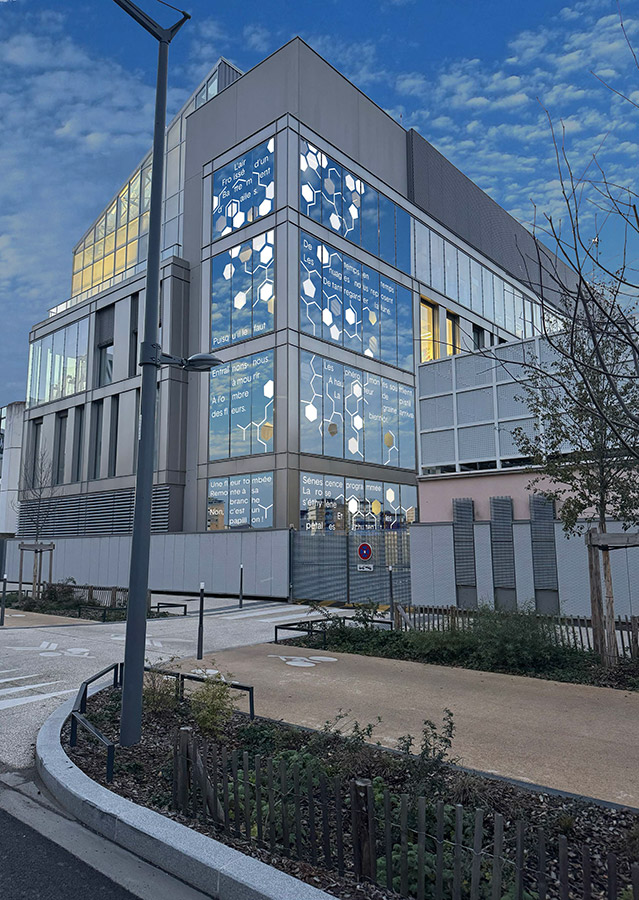
In September 2021, after more than two years of construction, ENS de Lyon received the keys to the M8 building. This new 3,200 m² space now houses the teams from the Lyon Geology Laboratory – Earth, Planets, Environment (LGL-TPE) and the Plant Reproduction and Development Laboratory (RDP). Its construction was part of the Lyon Cité Campus project and met the legal requirement for the decoration of public buildings, known as the 1% for art (1% artistique).
This mechanism, which allocates 1% of the construction budget for a public building to a work of art, aims to democratize art and create a dialogue between artistic creation and collective living spaces. In this context, a call for applications for the 1% for art for the M8 building was launched in spring 2023.
The winning project: “Éclosion du visible” (Emergence of the Visible)
Of the 48 applications received, three projects were shortlisted before the artistic committee selected the winner in May 2025: Capucine Vanderbrouck.
Her project, “Éclosion du visible” (Emergence of the Visible), explores perception, light, and matter, resonating with the scientific activities carried out within the RDP and LGL-TPE. The title evokes a gradual revelation, an emergence of forms or meanings, inviting the public to engage in an experience that is both sensory and reflective.
Capucine Vanderbrouck starts from a powerful observation: art and science share the same ambition—to reveal what escapes the naked eye in order to better understand the profound dynamics of the world. By focusing on the invisible, the artist questions the boundary between what can be seen and what can be guessed, where the visible unfolds.
A two-part work
The work will take two forms:
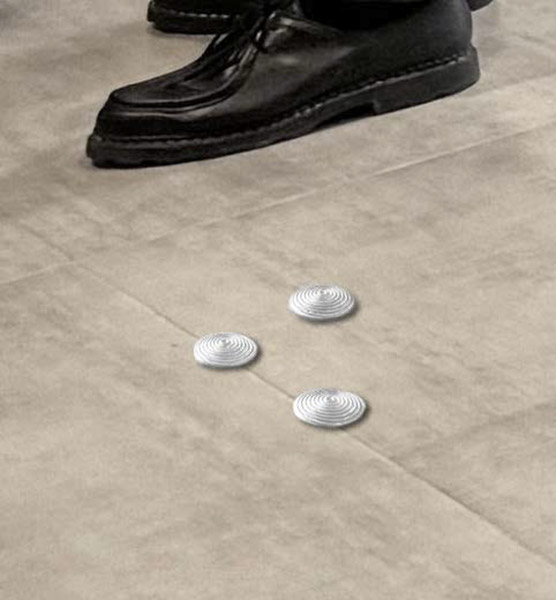
- On the outdoor plaza at the entrance to the building, an installation made up of tactile paving stones will form a haiku in Braille, accessible to all. The poem, which translates as follows: “6,361 kilometers of invisibility between our feet and the inner core,” evokes the distance that still separates us from the center of the Earth—an invisibility that science is striving to explore. Haiku, a short and structured Japanese poetic form, was chosen for its ability to capture the essence of a moment in connection with nature.
- On the glass corner of the building, visible from the street, a window sticker will complete the installation. Designed in collaboration with the building's users, it will bring together elements and molecules selected with scientists from M8, as well as haikus written during a writing workshop led by Elsa Escafre, visual artist and poet. The graphic composition will then be developed with graphic designer Ramel Luzoir.
The different stages
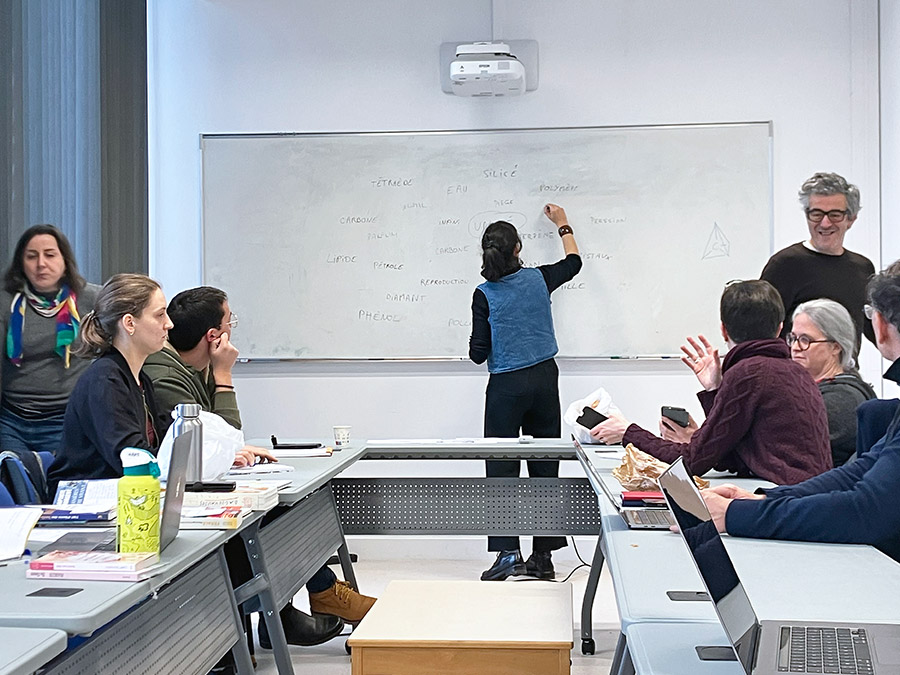
In November 2025, a writing workshop brought together users of the M8 building to imagine the elements of the future window stickers. Congratulations to the researchers from the plant reproduction and geology laboratories, who lent themselves to this artistic exercise. Starting with scientific descriptions of elements at the boundary between minerals and living organisms, they worked with poet and visual artist Elsa Escaffre to transform their observations into poetic haikus.
The artworks are expected to be installed in February-March 2026, followed by the creation of educational tools (booklets, panels, and a drone-filmed video).
The official inauguration of the building and artwork is scheduled for September 2026.
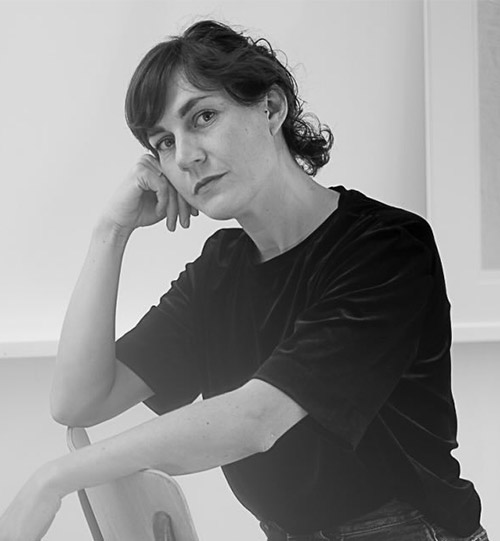
Capucine Vandebrouck
Capucine Vandebrouck is a visual artist born in Tourcoing. She uses sculpture and alternative photography to explore the concepts of life, transience, and the ultra-thin.
Her work has been exhibited in France and internationally for fifteen years and is featured in the collections of prestigious institutions such as the Museum of Modern and Contemporary Art in Strasbourg, the FRAC Alsace, and the CNAM. She currently collaborates with three galleries in Paris, Berlin, and Ghent.