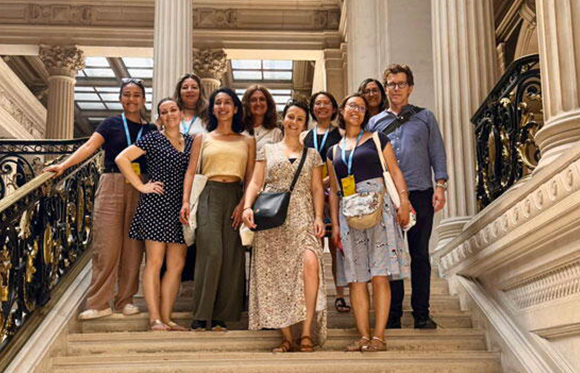
Since its inception in 2024, the Nanomer project—which brings together European and Latin American institutions focused on nanoscience—has given rise to several initiatives in both education and research. Here’s a look back at the activities in which ENS de Lyon participated in 2025-2026 and at upcoming projects.
Advancing education in the nanosciences, promoting pedagogical innovation, and encouraging the international exchange of best practices: these are the goals of the Nanomer project. Now bringing together 16 partner institutions from Europe and Latin America, with ENS de Lyon serving as coordinator, the project continues to grow through a variety of initiatives aimed at students, faculty, and researchers.
The 2025-2026 academic year was marked by several initiatives in which ENS de Lyon participated, which concretely illustrate this momentum. As new projects are being prepared for the current academic year, here is a look back at the actions carried out over the past year and the prospects for the future.
Exploring new academic and scientific environments
Among the key components of the Nanomer project are student training and educational innovation. For students, the various initiatives developed as part of the project aim to foster the development of transferable skills, such as critical thinking, communication, and public speaking. For faculty, these initiatives encourage the exchange of experiences and the sharing of best practices.
Student mobility
One of Nanomer’s key activities is study abroad in a foreign laboratory—an immersion in a new scientific environment. As part of this program, thanks to an Erasmus+ grant, undergraduate and graduate students from partner universities in Latin America can join a French or Spanish institution and gain international research experience.
In 2025, Sébastian Zangoni, a doctoral student at the University of Buenos Aires, joined ENS de Lyon for a research stay at the Chemistry Laboratory. This was his first research experience outside of Argentina.
In Lyon, he discovered new synthetic approaches and worked on materials with properties different from those prepared in Argentina. This experience allowed him to broaden his perspective on nanoscience and expand his international scientific network. He will return to the Chemistry Laboratory after defending his dissertation in Buenos Aires with a postdoctoral fellowship to continue the project he started.
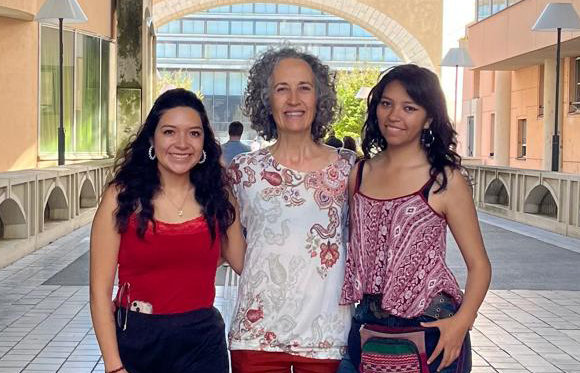
New exchange programs have since been established. In September 2026, Wara Echazu, a Master's student at the Universidad Mayor de San Andrés in Bolivia, and Yadira Collahuazo, a doctoral student at the Universidad Técnica Particular de Loja in Ecuador, joined ENS de Lyon for a three-month stay. They are in for some wonderful experiences!
Exchanges Of Faculty Members and Researchers
In addition to the experiences offered to undergraduate and graduate students, Nanomer also promotes exchanges among faculty members and researchers from partner institutions. The visit by Galo Soler-Illia to ENS in Lyon is a concrete example of this.
As a professor at the University of Buenos Aires, director of the Institute of Nanosystems (UNSAM), and principal investigator at CONICET, Galo Soler-Illia has been affiliated with the Chemistry Laboratory at ENS de Lyon since 2023. His research focuses in particular on hybrid materials, sol-gel synthesis, and mesoporous materials—fields that align with the work conducted within the laboratory.
Nanomer Workshops
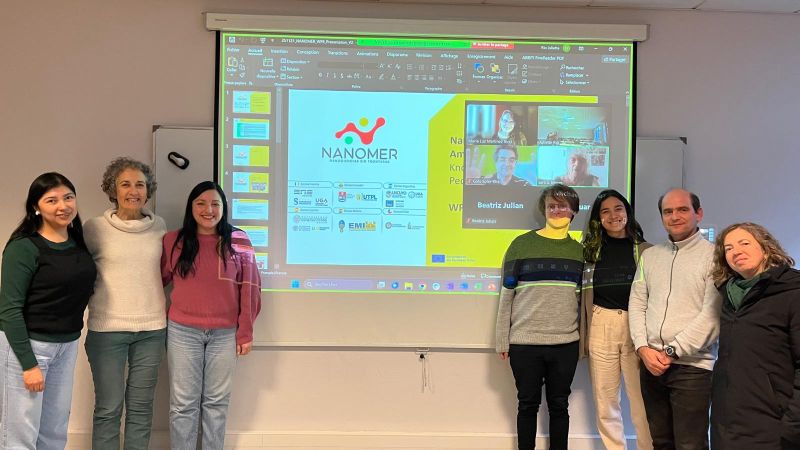
The exchange programs offered by Nanomer also include group activities among network members. A one-day workshop is organized during their stay, offering visiting students and doctoral candidates the opportunity to step outside the confines of their host laboratories, discover the work being conducted by other participants, and put their own research experiences into perspective. These gatherings help foster a true international community of young researchers in the field of nanoscience.
Following the first edition hosted at ENS de Lyon in November 2025, the workshop will move to Castellón, Spain, in 2026. On this occasion, the Universitat Jaume I will bring together the 12 students and doctoral candidates currently participating in the network’s exchange program.
Advancing Teaching Practices Through Webinars
To support the evolution of teaching practices, Nanomer is also expanding its discussions to include topics that go beyond the field of nanoscience.
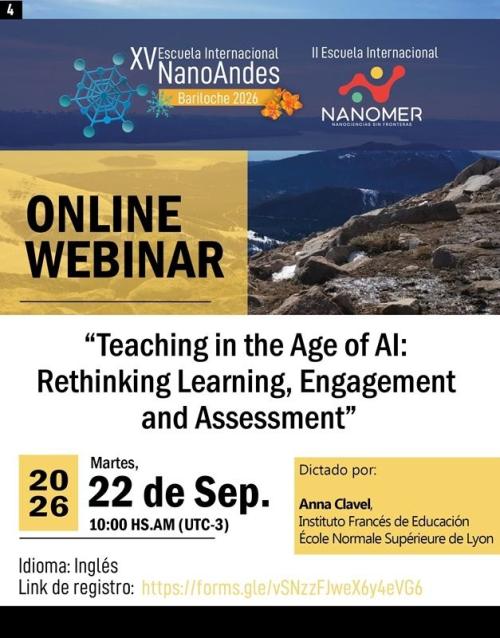
Remote webinars and workshops provide opportunities to share experiences and draw on complementary expertise. For example, as part of the preparations for the NanoAndes and Nanomer 2026 schools, a webinar was held on teaching in the age of artificial intelligence. Moderated by Anne Clavel, a research fellow at the French Institute of Education at ENS de Lyon, this webinar shed new light on the challenges of AI in education. This example illustrates how Nanomer operates: broadening dialogue by bringing together experts from other fields, thereby fostering pedagogical innovation through an interdisciplinary approach.
A Resource Library
Nanomer has a dedicated Moodle platform, developed at ENS de Lyon, which brings together the training videos produced as part of the project, as well as working documents and supplementary resources. This resource library is available, upon request, to interested members of the academic community.
The videos are also available on Nanomer’s YouTube channel, where you can find testimonials from various members of the network.
Sharing Best Practices in International Cooperation During the NANOMER Staff Training Week
Cooperation among members of the Nanomer consortium also relies on the staff who support international mobility and projects. In late June 2026, an international relations staff week was organized at Sorbonne University, in collaboration with ENS de Lyon and the Universitat Politècnica de València (Spain). It brought together colleagues from both continents to discuss best practices, international mobility, European funding opportunities, and the development of new partnerships.
ENS de Lyon helped organize the week, notably through a presentation by Karin Kim Lim, Head of International Cooperation and Partnerships, on the different types of international partnerships, titled “Partnership Typologies: Theory and Practice.”